
Coffee senna
Senna occidentalis
Description
How to tell it apart
Coffee senna is an annual herb or subshrub belonging to the Fabaceae family. The plant grows to a height of 0.5 to 1.5 meters and emits a distinct, unpleasant odor when the foliage is crushed.
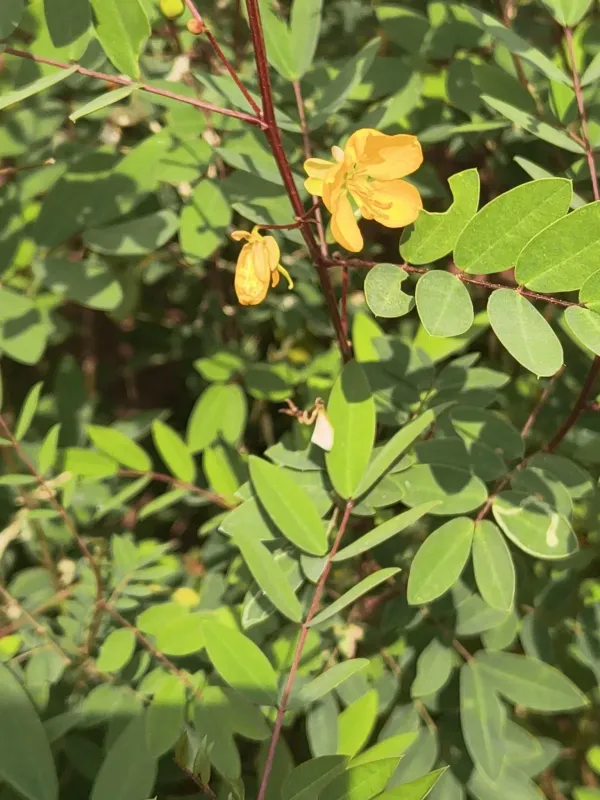
The stems are erect and often exhibit a reddish hue. The leaves are alternate, compound, and paripinnate, consisting of 4–5 pairs of lanceolate leaflets with acuminate tips.
The flowers are arranged in short, axillary racemes. Each flower features a five-petaled yellow corolla, which makes the plant easily recognizable during the blooming period.
The fruits are linear, slightly flattened pods that reach up to 12–15 centimeters in length. When mature, these pods darken and eventually release numerous seeds.
The seeds are hard, smooth, and dark brown, possessing a tough seed coat that allows them to remain viable in the soil for several years.
Where it grows
Coffee senna is widely distributed throughout tropical and subtropical regions. It thrives in well-lit, disturbed areas and can quickly colonize empty spaces.
It frequently inhabits wastelands, roadsides, fencerows, and areas near water bodies. It is highly adaptable to various soil types, including poor or nutrient-depleted soils.
In agricultural settings, it is a significant weed in row crops, particularly in soybeans, corn, cotton, and various vegetable plantations where it competes for resources.
The weed spreads primarily through contaminated agricultural equipment, water runoff, and movement by livestock or wildlife that may ingest the seeds.
Due to its rapid growth rate, it often establishes dense stands that can shade out emerging crop seedlings, giving the weed a competitive advantage.
Harm it causes
The primary concern with Coffee senna is its high toxicity. It contains anthraquinones and other compounds that can cause severe poisoning in livestock, particularly cattle.
As an aggressive weed, it competes heavily with crops for water, sunlight, and soil nutrients, leading to significant yield reductions in infested fields.
When seeds are harvested alongside crop yields, they contaminate the grain. This reduces the commercial value of the crop and may pose risks if used for animal feed.
The plant exhibits allelopathic properties, releasing chemical substances into the soil that inhibit the germination and growth of neighboring beneficial plants.
High infestations increase the labor and cost of field management, making mechanical weeding difficult and complicating the harvesting process due to high biomass.
How to control
Effective management begins with robust crop rotation and the maintenance of a competitive crop canopy to suppress weed seedling development.
Mechanical control through deep tillage is effective at burying seeds, while timely inter-row cultivation targets young seedlings before they develop deep taproots.
Chemical control involves the use of selective herbicides, particularly post-emergence treatments that are effective against broadleaf weeds in specific crop systems.
Integrated weed management must prioritize preventing seed production by removing or mowing infestations along field borders and non-crop areas.
- Utilizing clean, certified seeds to prevent introduction.
- Thoroughly cleaning machinery to avoid moving seeds between fields.
- Implementing precise herbicide programs based on local infestation levels.
Taxonomy
- Latin name
- Senna occidentalis
- Family
- Бобовые
- EPPO code
- CASOC