
Psoralea lanceolata
Psoralea lanceolata
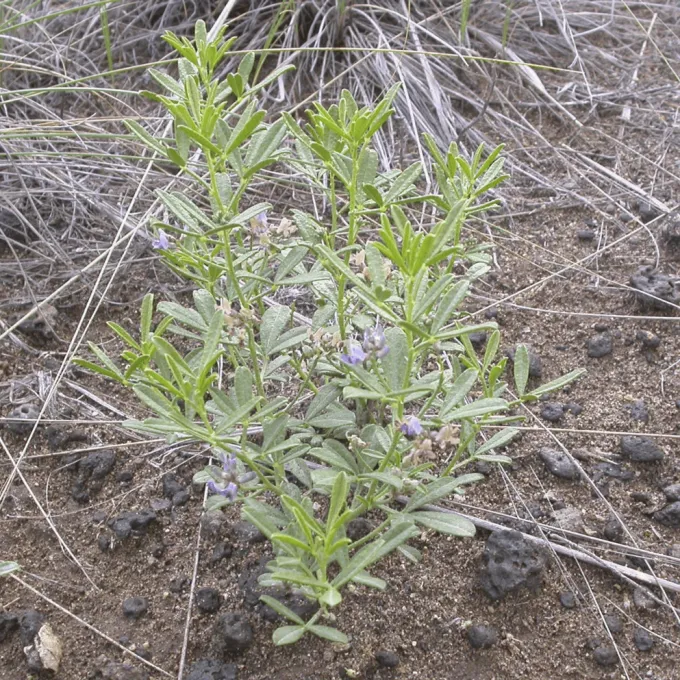
Description
How to tell it apart
Psoralea lanceolata, commonly known as lemon scurfpea, belongs to the Fabaceae family. It is a perennial herbaceous plant recognized for its resilient nature.
The plant typically grows 30–60 cm tall with an erect, branched stem. The leaves are lanceolate, alternate, and feature distinct glandular dots on the surface.
Flowers are arranged in racemes and appear in shades of white or yellowish-purple. Blooming occurs in mid-summer, making it identifiable during the active growth phase.
The fruit is a one-seeded pod. Due to the hard seed coat, the seeds can remain viable in the soil for extended periods, contributing to long-term infestation.
It possesses a deep, robust taproot system, which allows the plant to thrive in harsh environments and withstand extreme drought conditions.
Where it grows
Native to North America, Psoralea lanceolata is widely found in arid regions, prairies, and sandy soils where it can outcompete other native vegetation.
In agricultural settings, it frequently infests cereal crops and fallow lands, particularly in regions where soil moisture is a limiting factor for crops.
The weed is commonly seen along roadsides, railway embankments, and abandoned pastures, serving as a primary source for spreading seeds into adjacent fields.
It has a high tolerance for saline conditions and low-nutrient soils, enabling it to colonize areas that are difficult for standard crops to establish in.
The plant thrives in open, sunny spaces and can rapidly form dense colonies that dominate the local vegetation profile if left unmanaged.
Harm it causes
The primary economic damage is caused by aggressive competition for water and soil nutrients, which significantly suppresses the yield of cultivated crops.
The deep roots deplete deep soil moisture, stressing crops during critical growth stages and reducing their ability to withstand climatic fluctuations.
Psoralea lanceolata can be toxic to livestock if ingested in large quantities, posing a safety risk in pasture and grazing management systems.
The dense foliage and stem mass interfere with harvesting equipment, increasing downtime and the moisture content of harvested grains.
As a resilient perennial, it disrupts crop uniformity and requires repeated control interventions, leading to increased production costs for farmers.
How to control
Integrated weed management is essential. Deep tillage is recommended to disrupt the taproot system and prevent the regeneration of the plant.
Systemic herbicides, particularly those based on glyphosate, are most effective when applied during the post-harvest period to reach the root structure.
Implementing a crop rotation that utilizes competitive cover crops can help shade out the weed and limit its ability to establish or spread.
Sanitation practices, such as cleaning agricultural machinery between fields, are critical to preventing the spread of seeds to non-infested areas.
- Use of systemic herbicides in fallow fields.
- Strategic deep plowing to exhaust root energy reserves.
- Monitoring field borders to prevent encroachment.
Taxonomy
- Latin name
- Psoralea lanceolata
- Family
- Бобовые
- EPPO code
- PSRLA