
Purple milk vetch
Oxytropis halleri
Description
How to tell it apart
Purple milk vetch (Oxytropis halleri) belongs to the Fabaceae family. It is a perennial herbaceous plant with a strong taproot system that can penetrate deep into the soil profile.
The plant is characterized by pinnate leaves, often covered with silky hairs, which gives them a distinct silvery appearance under sunlight.
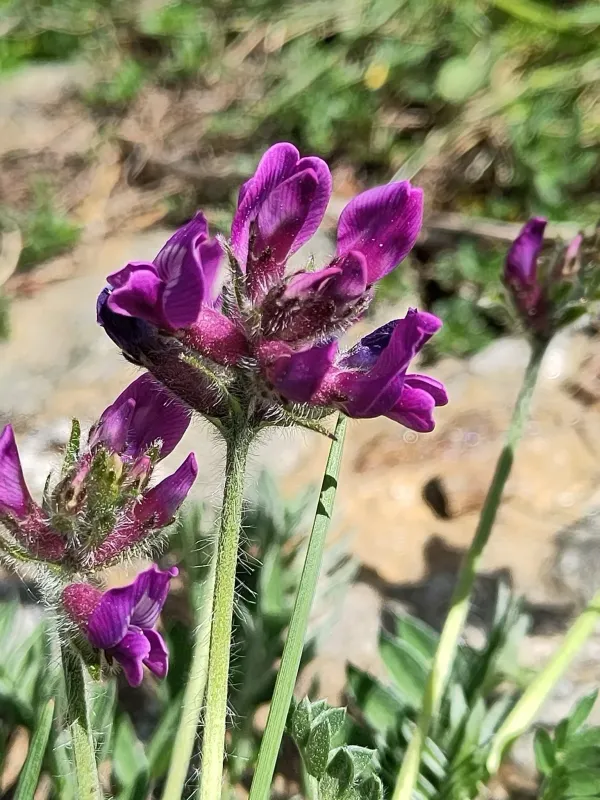
Its inflorescences are dense clusters of purple or violet flowers, which are typical for this genus and make it easily recognizable during the flowering phase.
The fruits are pods containing small seeds that are capable of being dispersed by wind and agricultural equipment across large areas.
As a resilient perennial, it possesses a high capacity for regeneration, allowing it to re-establish itself even after mechanical disturbance of the topsoil.
Where it grows
The distribution of Oxytropis halleri ranges from Spain to the UK, including Central Europe, the Balkans, and Ukraine. It is commonly found in dry meadows, pastures, and rocky slopes.
In agricultural settings, it acts as a weed in pasture lands and permanent grasslands, where it often colonizes degraded soils or areas with poor turf density.
It can occasionally be found in field crops, particularly under minimum tillage regimes where perennial weeds are not adequately controlled by mechanical cultivation.
The species prefers well-lit environments and avoids dense canopy cover, which is why it thrives in sparsely populated grasslands or unmaintained field margins.
It is capable of growing in various soil types, including nutrient-poor or rocky soils, which allows it to persist in non-arable patches within farm landscapes.
Harm it causes
The primary agricultural impact of purple milk vetch is the reduction of forage quality and total biomass production in pasture and hay meadows.
It competes aggressively with valuable forage grasses and legumes for essential soil moisture and nitrogen, reducing the carrying capacity of the land for livestock.
Its presence in field crops can complicate harvesting operations, leading to higher moisture content in grain and potential issues with weed seed contamination.
Furthermore, if left unmanaged, it acts as a reservoir for weed seeds, which can spread to adjacent cultivated fields through farm machinery and wind.
While not universally toxic, some related Oxytropis species have been associated with issues in livestock grazing, making its presence in forage highly undesirable.
How to control
Mechanical control through deep moldboard plowing is effective in disrupting the taproot system and preventing the plant's seasonal recovery.
Integrating row crops into the rotation allows for mechanical inter-row cultivation, which significantly reduces the population of established perennial weeds.
Chemical control involving systemic herbicides is recommended for larger infestations, targeting the plants during their active growth stage prior to flowering.
- Monitor fields for early detection.
- Spot-spray localized patches to minimize chemical usage.
- Maintain a vigorous crop canopy to outcompete the weed.
Proper pasture management, including controlled grazing and overseeding with competitive grass species, helps prevent the encroachment of Oxytropis halleri.
Taxonomy
- Latin name
- Oxytropis halleri
- Family
- Бобовые
- EPPO code
- OXRHA