
Cut-leaved medic
Medicago laciniata
Description
How to tell it apart
Cut-leaved medic (Medicago laciniata) is an annual herbaceous plant belonging to the Fabaceae family. Its common name refers to the deeply incised or 'cut' appearance of its leaflets.
The stems are typically prostrate or ascending and branch heavily from the base, often forming dense mats when the infestation is significant. The entire plant is covered in fine hairs and produces small yellow flowers arranged in compact clusters.
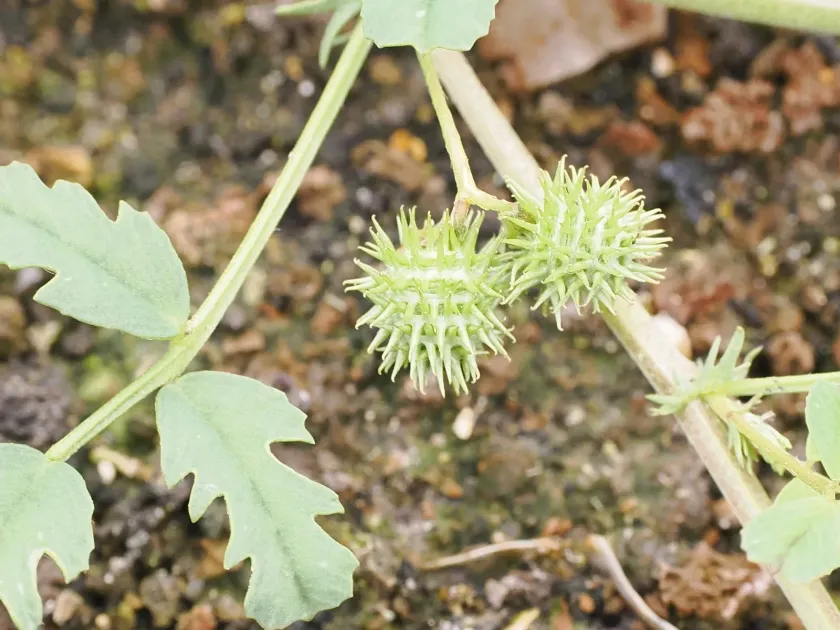
Its fruits are spiral, coiled pods covered in distinct prickles, which facilitate dispersal by attaching to animals, clothing, or farm machinery. The root system is a taproot that penetrates deep into the soil.
Biologically adapted to arid environments, it thrives in sandy or rocky soils. It completes its lifecycle quickly, producing numerous seeds that contribute to a long-lasting soil seed bank.
The species can be distinguished from other Medicago species by its deeply serrated leaves and the specific texture of its prickly pods, which possess coarser appendages than related plants.
Where it grows
The cut-leaved medic is native to arid and semi-arid regions, including the Mediterranean basin, Western Asia, and various dry climates across southern Europe and other continents.
It frequently colonizes fallow lands, roadsides, pastures, and uncultivated areas. In agricultural settings, it poses a threat to grain and fodder crops, particularly in regions with limited rainfall.
The plant prefers sunny, well-lit sites with light-textured soils. It is notably tolerant of soil salinity, which allows it to thrive in reclaimed lands where other vegetation might struggle.
In cropping systems, it emerges early in the growing season, leveraging early moisture to outcompete crops for space and resources during the critical early development phase.
Its ability to rapidly colonize bare soil makes it a persistent nuisance in fields managed with reduced tillage or where crop rotation is insufficient to break its life cycle.
Harm it causes
The primary damage caused by cut-leaved medic is its high competition for water and soil nutrients, which can be devastating in water-limited agricultural zones.
The weed shades out young crop seedlings, significantly reducing biomass and final yield, especially in crops with sparse stands. It can also act as a physical impediment during mechanical harvesting.
In fodder crops, the prickly pods are highly undesirable. When consumed by livestock, they can cause physical injury to the mouth and digestive tract, reducing the overall feed quality.
The plant serves as a host for various pathogens and insect pests that may migrate to legumes or other crops, increasing the need for additional pesticide applications.
Seed contamination is a major issue because the seeds of this weed are often similar in size and shape to those of desirable legumes, making mechanical separation extremely challenging.
How to control
Agrotechnical management includes deep plowing to bury seeds at depths where they cannot emerge, and the consistent implementation of diverse crop rotations to prevent build-up.
Effective pre-plant tillage, such as light cultivation, is essential to kill emerging flushes of the weed before the main crop is sown, reducing initial competitive pressure.
Chemical control via selective herbicides is effective, particularly in cereal crops. Products targeting broadleaf weeds are typically recommended for post-emergence application.
- Ensuring the use of certified, weed-free seed lots.
- Mowing field edges and non-crop areas to prevent seed production.
- Utilizing herbicide programs aligned with regional growth stages.
On fallow ground or areas being prepared for planting, non-selective systemic herbicides such as glyphosate can be used to thoroughly kill the root system and prevent regrowth.
Taxonomy
- Latin name
- Medicago laciniata
- Family
- Бобовые
- EPPO code
- MEDLA