
Winged broom
Genista sagittalis
Description
How to tell it apart
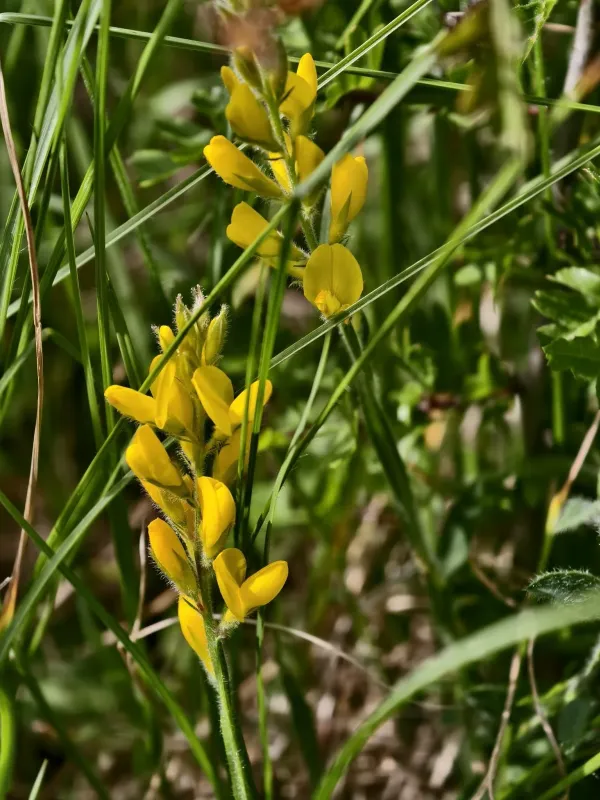
Winged broom (Genista sagittalis) is a low-growing perennial shrub belonging to the Fabaceae family. It is easily distinguished by its unique winged stems that have green appendages running along the length of the branch.
The plant typically reaches a height of 15 to 30 centimeters and often spreads along the ground, creating dense, tangled mats in open grassy areas.
Its leaves are simple and alternate, often featuring fine hairs, which is an adaptation that helps the plant thrive in nutrient-poor and dry environmental conditions.
The flowers are bright yellow, arranged in dense, terminal raceme inflorescences that bloom during the late spring and early summer months.
The fruits are small, hairy pods that contain seeds, which are scattered efficiently as the pods dry and split, allowing the plant to colonize new territories rapidly.
Where it grows
Winged broom typically occupies dry, sun-exposed habitats such as rocky slopes, forest edges, and poorly managed grasslands or heathlands.
In agricultural settings, it is a significant problem in extensive pastures and hay meadows where the soil is nutrient-poor, sandy, or acidic, providing a competitive advantage for the shrub.
The species is highly resilient to cold winters and can persist in degraded landscapes where other competitive vegetation has been lost due to overgrazing or soil erosion.
It is widespread across European temperate regions, where it often forms stable colonies on marginal lands that are infrequently disturbed by cultivation.
The plant's ability to fix nitrogen does not make it a benefit in this case, as it occupies space that should be used by more palatable or higher-yielding forage species.
Harm it causes
The main economic damage caused by winged broom is the severe reduction in the carrying capacity of pastures, as livestock find the plant unpalatable and often avoid grazing near it.
By forming dense, low-growing mats, the shrub effectively shades out other herbaceous species, reducing the botanical diversity and overall forage value of the grassland.
It acts as a problematic weed because its woody base and extensive root system make it difficult to eliminate through simple mechanical weeding methods once established.
In regions where agricultural production depends on high-quality hay, the presence of this plant can contaminate the crop and reduce its market value.
The plant can also harbor various insects and diseases that may serve as secondary threats to other legume-based crops in the vicinity.
How to control
Mechanical control involves regular mowing or grazing management to prevent the plant from establishing dominant patches, effectively weakening its root system over time.
Deep plowing and soil cultivation are essential for removing established populations before replanting the land with competitive pasture grasses that can suppress regrowth.
Chemical control utilizing broad-spectrum systemic herbicides is often the most effective method for eradicating large patches, ideally applied during the peak growth season.
Integrated weed management should include long-term soil monitoring and the use of targeted herbicides that minimize damage to the surrounding desirable vegetation.
- Repeated mowing to exhaust root stores
- Deep soil cultivation (plowing)
- Systemic herbicide application
- Strategic grazing to prevent establishment
Taxonomy
- Latin name
- Genista sagittalis
- Family
- Бобовые
- EPPO code
- CMVSA