
Hairy greenweed
Genista pilosa
Description
How to tell it apart
Hairy greenweed (Genista pilosa) is a perennial subshrub belonging to the Fabaceae family. It typically reaches 15–40 cm in height and grows in dense, sprawling mats or cushion-like structures.
The leaves are simple, alternate, and narrowly elliptical. They are densely covered with pressed hairs, which gives the plant a silvery-green appearance and protects it from excessive transpiration.
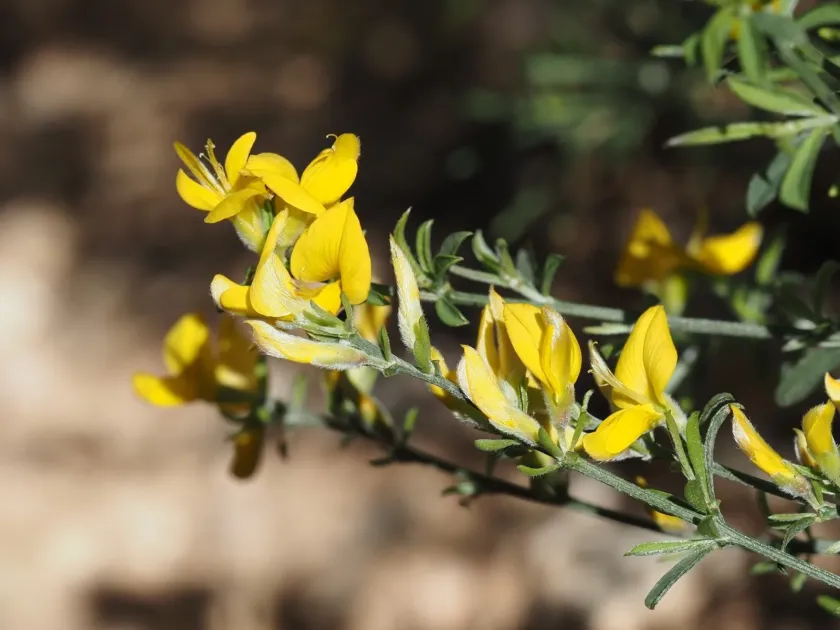
Flowers are golden-yellow, arranged in short racemes at the tips of the shoots. Flowering usually occurs from May through June, making the plant easily distinguishable within a field.
The fruit is a pubescent pod containing several small seeds. The root system is deep and taprooted, providing the plant with excellent access to soil moisture even in harsh conditions.
The plant exhibits high regenerative potential: if the aerial parts are cut or damaged, it quickly resprouts from dormant buds located near the root crown or along the base of the stems.
Where it grows
Hairy greenweed prefers sandy, nutrient-poor, and acidic soils. It is commonly found in dry, sunny areas, wastelands, heathlands, and thin forest edges where competition is low.
In agricultural settings, it often infests permanent pastures, hay meadows, and fields with sandy soil profiles where it can easily establish itself between the crop rows.
The presence of this weed serves as an indicator of low soil fertility and acidity. Its ability to tolerate low nutrient levels allows it to thrive where more demanding crops struggle.
It frequently spreads from bordering non-arable lands into production fields, taking advantage of soil disturbance or gaps in the crop canopy to colonize new spots.
Seeds are dispersed mainly by wind and animal activity, helping the plant to migrate across landscape patches and infest previously unaffected farmland.
Harm it causes
The primary agricultural harm caused by Hairy greenweed is its role as a strong competitor for water and limited soil nutrients, which can significantly reduce crop yield.
In pastures, this plant is problematic because it contains alkaloids that make it unpalatable or mildly toxic to livestock, which leads to a decrease in overall forage quality.
Its dense mat-forming growth habit suppresses the growth of forage grasses and other desirable vegetation, physically shading them out and occupying valuable surface area.
Because of its robust taproot, it remains vigorous during dry spells when more sensitive crops wilt, giving it a competitive advantage in water-scarce environments.
The weed is notoriously difficult to eradicate via mechanical means; shallow tilling may break the roots into fragments, which can then resprout and lead to a thicker infestation.
How to control
Effective mechanical control involves deep plowing with full moldboard inversion, which disrupts the root system and prevents the plant from regenerating from its base.
Improving soil fertility and managing pH levels through liming is critical, as Hairy greenweed is less competitive in healthy, non-acidic soil environments.
In meadows or pastures, frequent mowing before the flowering stage helps deplete root reserves, gradually weakening the plant over several seasons.
Chemical control usually requires the application of systemic herbicides (e.g., glyphosate or selective broadleaf herbicides) to ensure the chemical reaches the root system effectively.
- Deep tillage for soil inversion.
- Liming to correct soil acidity.
- Repeated mowing in non-cultivated areas.
- Application of systemic herbicides during peak growth.
Taxonomy
- Latin name
- Genista pilosa
- Family
- Бобовые
- EPPO code
- GENPI