
Spanish gorse
Genista hispanica
Description
How to tell it apart
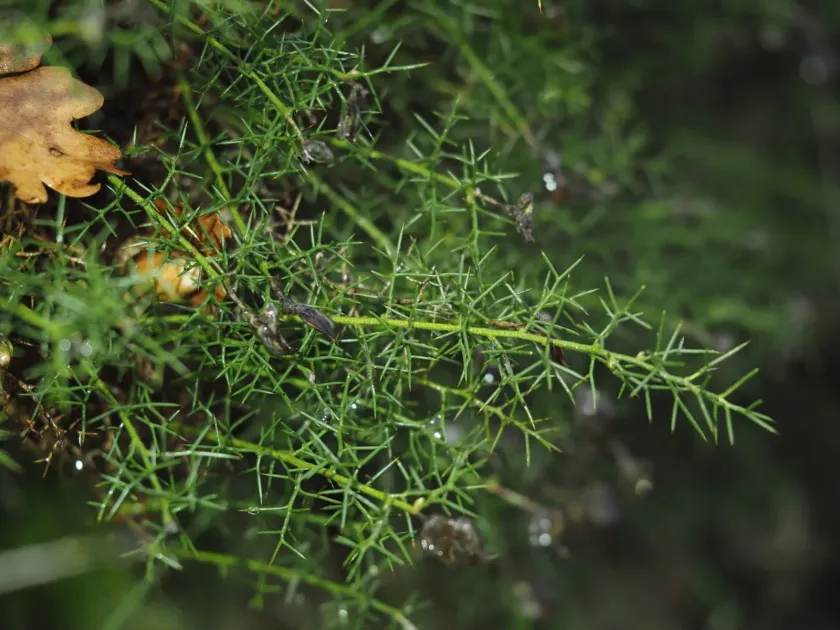
Spanish gorse (Genista hispanica) is a dense, thorny shrub belonging to the Fabaceae family, typically growing to a height of 30–60 cm. It forms compact, cushion-like mounds that can rapidly dominate open areas.
The stems are characterized by numerous rigid, sharp spines, which are modified branchlets. The leaves are small, simple, and lanceolate, often dropping during drought periods, which emphasizes the shrub's prickly appearance.
During its flowering season in late spring and early summer, the shrub is covered in bright yellow papilionaceous flowers arranged in dense terminal racemes. The flowers are highly aromatic, making them attractive to various pollinators.
The fruit is a short, pubescent pod containing several hard seeds. These seeds are characterized by long-term viability, which allows the plant to persist in the soil seed bank for several years.
The plant possesses a deep taproot system, which provides excellent drought tolerance and allows it to effectively compete for moisture and nutrients in harsh, impoverished soil conditions.
Where it grows
Native to the Mediterranean region, Spanish gorse thrives in sunny, rocky habitats and open slopes. It is highly adapted to soils with low fertility where other competing vegetation struggles to establish.
In an agricultural context, it is commonly found on abandoned pastures, fallow fields, field margins, and along roadsides. It is an opportunistic colonizer of disturbed or neglected lands.
The shrub displays high ecological plasticity, enabling it to grow well in various soil types, particularly those with good drainage. Once established, it can spread through vegetative growth and seed dispersal.
On grazing lands, Spanish gorse displaces valuable forage species, leading to the degradation of pastoral quality. It quickly occupies gaps left by overgrazing or poor management practices.
The plant is resilient to extreme temperature fluctuations and dry conditions, allowing it to expand its range into areas where soil degradation has hindered the growth of more sensitive crops.
Harm it causes
The primary agricultural impact of Spanish gorse is the creation of dense, thorny thickets that physically obstruct field operations. Mechanical cultivation and harvesting are rendered difficult or impossible in infested zones.
As an aggressive competitor, the shrub consumes substantial moisture and nutrient resources, causing significant growth suppression in nearby crops. On pastures, it reduces the availability of edible vegetation.
The thorns prevent livestock from grazing in infested areas, effectively reducing the functional acreage of a pasture. Animals will avoid these thickets, leading to inefficient land utilization.
Spanish gorse exhibits allelopathic properties, with its roots releasing chemical compounds into the soil that inhibit the germination and growth of neighboring plant species, further reducing crop yields.
The accumulation of dry, flammable biomass within the shrub's cushion-like structure creates a serious fire hazard. In high-risk seasons, these thickets can facilitate the rapid spread of wildfires across agricultural fields.
How to control
Agrotechnical control methods primarily involve deep plowing with soil inversion, which physically disrupts the root system and forces the plants to the surface to dry out. Repeated operations are necessary for long-term efficacy.
Regular mowing helps prevent seed set and limits the outward expansion of existing patches. However, this method should be part of an integrated program, as old plants can regenerate from the root crown.
Chemical control using systemic herbicides is effective when applied during the active growth phase. This ensures the herbicide is translocated into the deep taproot, leading to complete plant death.
On pastures, integrating mowing with the reseeding of competitive forage grasses is recommended. A vigorous, dense canopy of grass limits the light available for germinating gorse seedlings.
- Deep plowing and soil inversion.
- Systematic mowing to prevent flowering.
- Application of systemic herbicides during active growth.
- Reseeding with competitive grass species.
- Manual removal of individual plants before seed production.
Taxonomy
- Latin name
- Genista hispanica
- Family
- Бобовые
- EPPO code
- GENHI