
Echinospartum horridum
Echinospartum horridum
Description
How to tell it apart
Echinospartum horridum is a dense, highly branched spiny shrub belonging to the Fabaceae family. Mature specimens form tight, hemispherical cushions that can reach heights of up to 50-60 centimeters, creating impenetrable barriers.
The stems are covered in hard, sharp thorns which are essentially modified lateral branches. The leaves are very small and often drop off early, making the stems the primary photosynthetic organs, which is an adaptation to harsh environmental conditions.
The flowers are typical of the legume family, possessing a butterfly-like shape, and are colored bright yellow. They appear in terminal clusters, making the plant visually distinct but causing significant operational difficulties due to its dense, prickly structure.
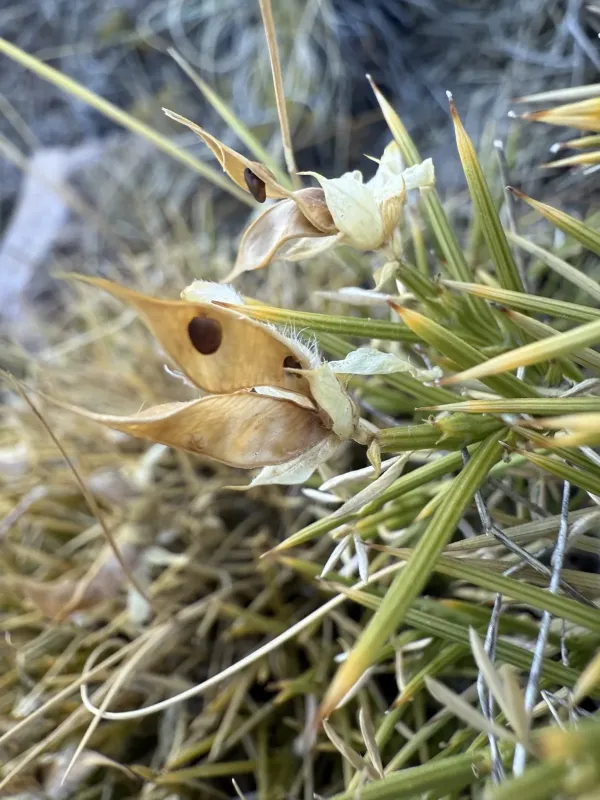
The fruit is a hairy pod containing several hard seeds with high germination potential. These seeds remain viable in the soil for extended periods, contributing to the plant's ability to persist and spread within agricultural areas.
It possesses a strong, deep-reaching taproot system. This allows the shrub to compete successfully with crops for water and mineral nutrients, particularly in rocky or nutrient-poor soils where other plants struggle to establish.
Where it grows
The primary range of Echinospartum horridum includes mountainous and foothill regions of the Iberian Peninsula. It thrives on sunny, open sites with calcareous soils, where it forms extensive communities that outcompete forage grasses.
In pastures and meadows, this shrub tends to expand rapidly if grazing pressure is reduced. It is highly resistant to strong winds and extreme temperature fluctuations, allowing it to dominate areas that are otherwise considered marginal land.
In the agricultural sector, the damage from this shrub is particularly notable on permanent pastures located near mountainous terrain. It creates dense thickets that block livestock access to more valuable forage resources.
The plant is highly adapted to poor, stony substrates where it faces minimal competition. Its tendency for expansion complicates the reclamation of new lands for intensive agriculture in sub-mountainous zones.
While native to specific shrubland ecosystems, human-induced environmental changes have allowed Echinospartum horridum to behave as an aggressive weed, necessitating intervention by agronomists to protect productivity.
Harm it causes
The main threat posed by Echinospartum horridum is the formation of continuous spiny thickets. This results in a direct loss of productive pasture area, as livestock are unable to graze in the locations colonized by the shrub.
The presence of sharp thorns on the branches creates serious risks of livestock injury. Animals attempting to graze near the plant often suffer from lacerations to their mucosal membranes and skin, leading to reduced herd health.
The shrub is a strong competitor for nutrients. Its deep roots effectively extract nitrogen and moisture, leaving forage crops in a state of chronic resource deficiency, which significantly reduces total biomass production.
Echinospartum horridum hinders the use of agricultural machinery. Attempting mechanical clearing often leads to damage to tillage implements and mowers, resulting in increased maintenance and repair costs for farmers.
Due to the high density of the shrub, there is a degradation of the meadow botanical composition. Useful legumes and grasses are gradually suppressed, leading to a decline in the quality and economic value of the grazing land.
How to control
Agrotechnical control methods include systematic clearing followed by deep plowing. It is essential to remove the root system entirely, as the plant is capable of regenerating from dormant buds if only the above-ground biomass is removed.
Implementing intensive grazing management in the early stages of shrub development can help suppress its spread. Young shoots may be grazed by livestock, which weakens the overall vigor of the weed population.
Chemical control is the most effective approach for large areas. The use of systemic herbicides based on glyphosate or triclopyr during the active growth phase is recommended to ensure the destruction of the root system.
Efficiency can be improved by using backpack sprayers for targeted application directly onto the bushes. This minimizes the amount of chemical used and reduces the impact on the surrounding beneficial vegetation.
After clearing the shrub, it is crucial to overseed with fast-growing perennial grasses to establish a dense cover. This prevents the seeds remaining in the soil from germinating and re-infesting the cleared field.
Taxonomy
- Latin name
- Echinospartum horridum
- Family
- Бобовые
- EPPO code
- ECSHO