
Desmodium triflorum
Desmodium triflorum
Description
How to tell it apart
Desmodium triflorum, commonly known as three-flowered tick-trefoil, is a prostrate perennial herb belonging to the Fabaceae family. Its stems are thin, trailing, and capable of rooting at the nodes when in contact with moist soil.
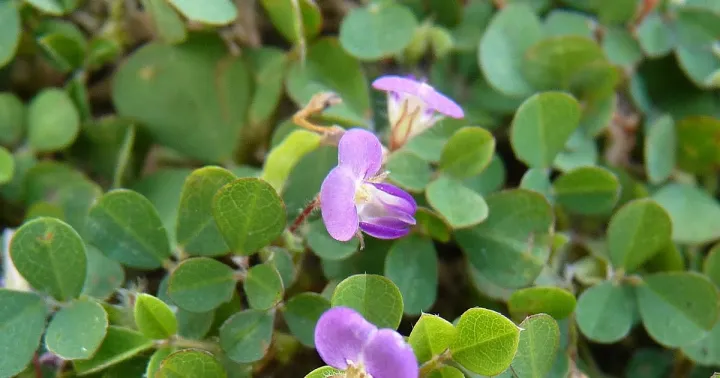
The leaves are trifoliate and small, featuring a characteristic obcordate shape. The presence of stipules is a distinct botanical marker used to differentiate this species from other prostrate legumes found in agricultural landscapes.
The flowers are small and range in color from pink to purple or sometimes white. They are arranged in axillary inflorescences, typically containing up to three flowers per cluster, which is the origin of its specific epithet.
The fruit consists of jointed, flat pods that break into individual segments upon maturity. These segments are covered in tiny, hooked hairs that enable them to attach easily to animal fur, clothing, and machinery for dispersal.
The plant possesses a robust and deep root system, which allows it to thrive in various environmental conditions and ensures survival during periods of moisture stress or after mechanical disturbance.
Where it grows
This weed is widely distributed throughout tropical and subtropical regions. It prefers open, disturbed habitats including pastures, roadsides, meadows, and abandoned farmlands where competition for space is initially low.
In cropping systems, Desmodium triflorum is particularly problematic in perennial plantations, such as coffee, tea, or rubber groves, where it spreads rapidly across the open ground between crop rows.
It thrives in well-drained soils but demonstrates high plasticity by adapting to various soil types, ranging from sandy textures to heavy clays. It prefers abundant sunlight for maximum biomass production.
It frequently colonizes lawns, golf courses, and sports fields, where its prostrate growth habit allows it to withstand regular mowing and eventually suppress the desired turfgrass.
Due to its ability to fix nitrogen, it often dominates in nutrient-poor soils, outcompeting other species that lack such symbiotic associations with nitrogen-fixing bacteria.
Harm it causes
The primary damage caused by this weed is the physical suppression of crop seedlings. Its dense, creeping mat growth shades out emerging plants, significantly reducing light availability during critical development stages.
Desmodium triflorum competes intensely for soil moisture and available nutrients. This competition is especially detrimental to young crops, often leading to reduced vigor and delayed maturity.
As a legume, it can serve as an alternative host for various viral and fungal diseases. These pathogens can be transmitted by insect vectors to economically important crops, causing significant yield losses.
In pasture systems, it can displace more nutritious forage grasses, leading to a decline in overall livestock feed quality and decreasing the carrying capacity of the land.
The presence of hooked seed segments in harvested products reduces the quality of the crop and necessitates expensive cleaning processes, increasing the cost of post-harvest handling and storage.
How to control
Mechanical removal is effective but labor-intensive. Because stem fragments can easily re-root, it is essential to ensure that the entire root system is removed during cultivation or manual weeding operations.
Cultural methods include deep tillage or harrowing, which disrupts the creeping stems and prevents the establishment of dense mats in preparation for the main planting season.
Mulching with organic matter or synthetic ground covers effectively denies the weed the sunlight it requires, leading to a significant reduction in its coverage and vigor over time.
Chemical control involves the application of systemic herbicides during the plant's active growth stage. Targeting the plant before it sets seed is crucial for preventing further spread across the field.
Implementing a crop rotation strategy that utilizes vigorous, canopy-closing crops can naturally suppress Desmodium triflorum by outcompeting it for light and physical space, thereby limiting its encroachment.
Taxonomy
- Latin name
- Desmodium triflorum
- Family
- Бобовые
- EPPO code
- DEDTR