
Florida beggarweed
Desmodium tortuosum
Description
How to tell it apart
Florida beggarweed (Desmodium tortuosum) is a member of the Fabaceae family, recognized as an aggressive annual weed in agricultural fields.
The plant features upright, hairy stems that can grow quite tall, sometimes reaching heights of up to two meters in undisturbed environments.
Leaves are trifoliolate, meaning each leaf consists of three distinct leaflets, which are typically ovate or elliptic in shape.
Flowers are small and arranged in racemes, displaying colors ranging from pink to purple, which bloom over an extended period.
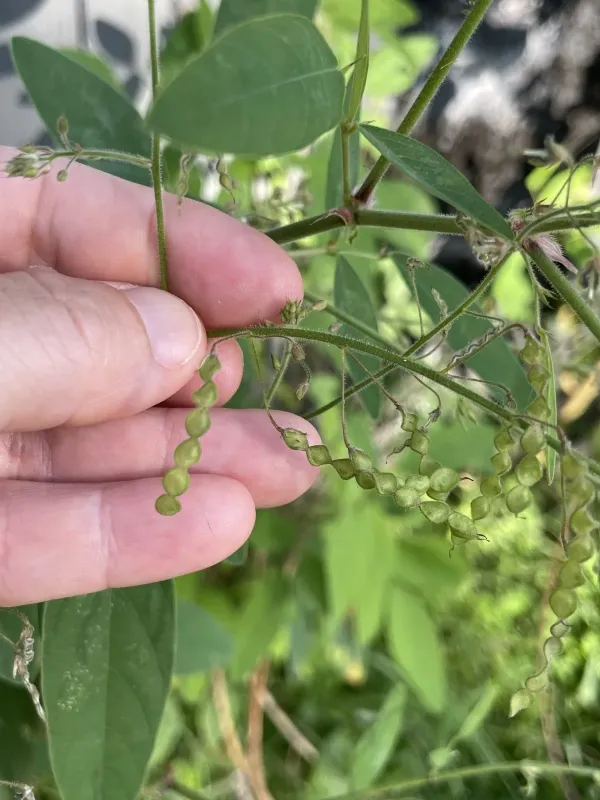
The fruit is a segmented loment, covered in tiny, hooked hairs that allow the seed pods to attach firmly to fabrics or animal fur.
Where it grows
Originating from tropical regions of the Americas, it has become a prevalent weed in many subtropical and temperate zones worldwide.
It is commonly found in row crops such as soybeans, peanuts, corn, and cotton, where it benefits from fertilization and irrigation.
The plant thrives in warm, moist soils and is particularly problematic in areas with high rainfall or managed irrigation systems.
Beyond crop fields, it frequently inhabits fence lines, ditches, roadsides, and uncultivated areas, serving as a source for annual re-infestation.
It colonizes disturbed soil rapidly, taking advantage of open space before crop canopies can close and provide natural shade.
Harm it causes
Florida beggarweed competes fiercely with crops for essential nutrients, water, and sunlight, often resulting in significant yield loss.
The dense foliage of the weed shadows the crop, stunting its growth and reducing the efficiency of photosynthesis during critical development stages.
Harvesting operations are frequently complicated by the weed, as the sturdy stems can clog machinery and contaminate the harvested grain.
It acts as a host for various diseases and pests, including root-knot nematodes, which can devastate neighboring susceptible crops.
The hooked seed pods are a nuisance in agricultural settings and can lower the market value of contaminated animal feed or hay products.
How to control
Effective control begins with proper tillage practices, such as deep plowing, to bury seeds and prevent emergence in the following season.
Crop rotation is a vital strategy, as rotating with dense-canopy crops can suppress the growth and germination of this sun-loving weed.
Mechanical cultivation between rows remains an effective method for destroying young seedlings before they develop a deep root system.
Chemical control involving selective herbicides is common; applications should be timed to target the weed while it is in the seedling stage.
Sanitation measures at field margins are crucial to stop the spread of seeds and ensure that the weed does not return year after year.
Taxonomy
- Latin name
- Desmodium tortuosum
- Family
- Бобовые
- EPPO code
- DEDTO