
Rattleweed
Crotalaria retusa
Description
How to tell it apart
Crotalaria retusa, commonly known as rattleweed, belongs to the Fabaceae family. It is an herbaceous perennial or annual plant with erect, branched stems growing up to 1 meter in height.
The leaves are simple, alternate, and have a distinctively notched or rounded tip. The underside of the leaves is usually covered in fine, silky pubescence, which is a key diagnostic feature.
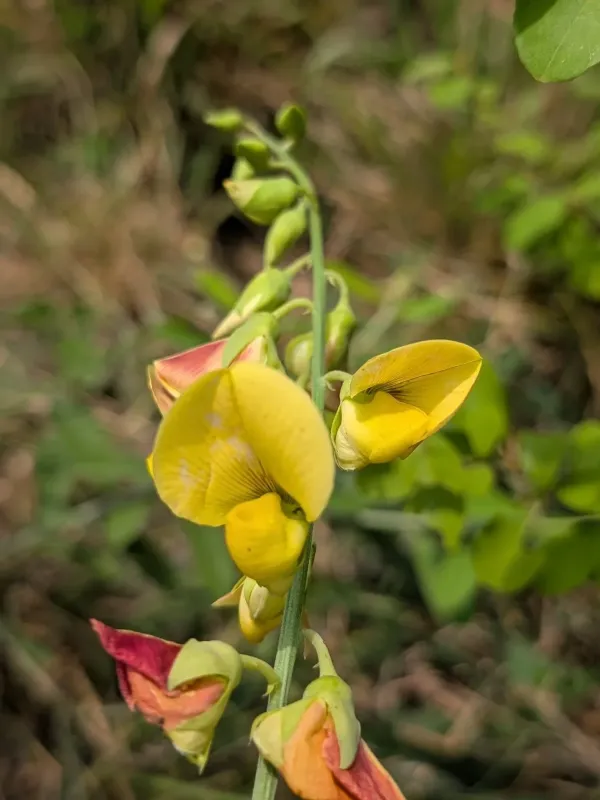
The plant produces showy yellow flowers in terminal racemes. These flowers often feature reddish or purple veins on the standard petal, typical of its legume classification.
The fruit is an inflated, cylindrical pod. As it matures, the pod turns brown or black, and the loose seeds rattle inside when shaken, which is the origin of its common name.
Its deep taproot system allows the plant to thrive in nutrient-poor or disturbed soils, granting it a competitive edge in various environmental conditions.
Where it grows
Rattleweed is primarily found in tropical and subtropical regions. It thrives in open, sunny locations, such as roadsides, disturbed landscapes, pasture edges, and fallow fields.
In agricultural settings, it frequently invades row crops and grazing pastures. It is known to colonize fields quickly after cultivation, posing a threat to crop health and establishment.
Harm it causes
The plant contains pyrrolizidine alkaloids, making it highly toxic to livestock. Ingestion can cause severe liver damage and chronic health issues in cattle, horses, and sheep.
Beyond its toxicity, it is a significant agricultural weed. Its rapid growth and hardy nature allow it to outcompete crops for sunlight, water, and nutrients, thereby reducing overall yields.
How to control
Mechanical control involves cutting or mowing the plants before they reach the flowering stage to prevent seed set and minimize the long-term seed bank in the soil.
Cultural practices such as deep tillage are effective for disrupting the taproot system and preventing the emergence of new seedlings in prepared seedbeds.
Chemical control focuses on the use of selective herbicides that target broadleaf weeds. Applications should be performed during the active vegetative growth phase for maximum efficiency.
- Monitor fields early in the season to identify young plants.
- Avoid overgrazing pastures to prevent the establishment of the weed.
- Ensure equipment is cleaned after moving through infested areas to stop seed dispersal.
Taxonomy
- Latin name
- Crotalaria retusa
- Family
- Бобовые
- EPPO code
- CVTRE