
Yellow wild indigo
Baptisia tinctoria
Description
How to tell it apart
Baptisia tinctoria, commonly known as yellow wild indigo, is a perennial herbaceous plant belonging to the Fabaceae family. It typically forms a bushy, shrub-like appearance, reaching heights of 60 to 90 centimeters.
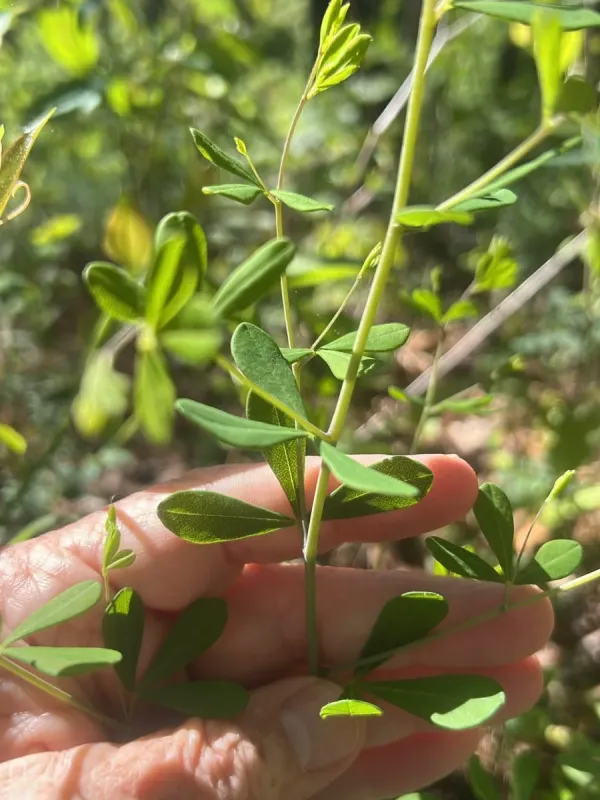
The plant features branched stems with distinctive blue-green trifoliate leaves. Each leaflet is relatively small and obovate in shape, which serves as a key diagnostic feature for field identification.
Its flowers are bright yellow, arranged in loose terminal racemes. The blooming period occurs in early to mid-summer, followed by the development of small, inflated seed pods that turn black upon maturity.
The root system is vigorous and deep, allowing the plant to thrive in competitive environments. The ability to propagate via both seeds and rhizomes makes it a persistent weed that is difficult to eradicate completely.
In agricultural settings, young seedlings may be identified by the specific glaucous waxy coating on their leaves, helping farmers distinguish them from other legumes at an early stage.
Where it grows
Yellow wild indigo prefers dry, sandy soils and open spaces. In the wild, it is frequently found on forest edges, meadows, and abandoned farmlands where competition from larger vegetation is limited.
As a weed, it is often documented in perennial forage crops, pastures, and along roadsides adjacent to cultivated fields. It is highly adaptable to nutrient-poor soils, allowing it to colonize marginal lands easily.
In agro-ecosystems, Baptisia tinctoria tends to establish itself when crop rotation is neglected or when minimal tillage practices are employed for several consecutive years. Its seeds remain viable in the soil for extended periods.
Though not always classified as a primary quarantine pest, its invasive nature allows it to displace beneficial flora. Spread often occurs through agricultural machinery or contaminated equipment moving between fields.
This species displays high resilience to environmental stressors, including prolonged droughts, which gives it a competitive edge over less hardy crop varieties in non-irrigated agricultural regions.
Harm it causes
The weed's primary impact lies in its aggressive competition for sunlight, soil moisture, and essential nutrients. Its deep root system allows it to access resources effectively, depriving surrounding crops of necessary growth factors.
In pastures, yellow wild indigo poses a specific threat because it contains alkaloids that can be toxic or unpalatable to livestock. Its presence significantly reduces the quality and quantity of available forage for grazing animals.
Thick stands of this weed create a dense canopy that maintains high humidity near the ground, which may promote the growth of fungal diseases in crops. Additionally, it hinders the efficiency of mechanical harvesting equipment.
Contamination of hay or silage with this species decreases the market value of the harvest. Farmers often face financial losses due to the necessity of additional cleaning and sorting procedures post-harvest.
Long-term presence of this weed exhausts the soil profile, as its deep taproot extracts nutrients from lower horizons, which are essential for the shallower root systems of many common cultivated crops.
How to control
Mechanical control focuses on deep tillage, which is effective for exposing and damaging the rhizomes of the plant, leading to desiccation. Regular discing during the early growth season helps suppress its population.
Implementing a rigorous crop rotation plan that includes row crops allows for frequent inter-row cultivation. This mechanical disruption is essential to prevent the weed from establishing a permanent colony in the field.
Chemical control requires careful planning due to the weed's botanical classification. Since it belongs to the Fabaceae family, standard herbicides used for legumes may be ineffective or damaging to the target crop.
Systemic herbicides, such as glyphosate, are most effective when applied during the late summer or post-harvest stage. During this period, the plant actively transports nutrients to the roots, ensuring the chemical reaches the entire system.
An integrated approach, combining mechanical cutting of rhizomes with targeted spot-treatment of herbicides, is the most sustainable strategy to reduce Baptisia tinctoria populations over a multi-year period.
Taxonomy
- Latin name
- Baptisia tinctoria
- Family
- Бобовые
- EPPO code
- BAPTI