
Woolly locoweed
Astragalus mollissimus
Description
How to tell it apart
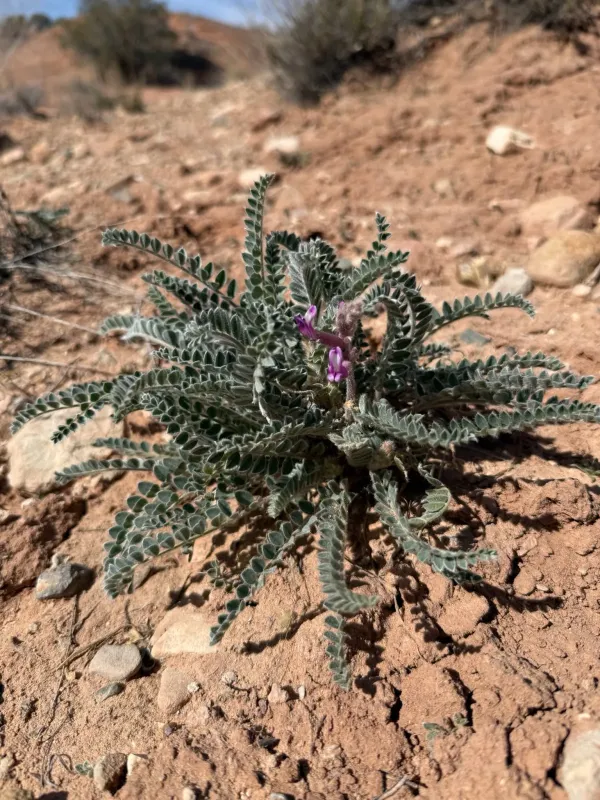
Woolly locoweed (Astragalus mollissimus) is a perennial herbaceous plant belonging to the legume family (Fabaceae). Its most distinctive feature is the dense covering of soft, white hairs, giving the plant a silvery appearance.
The stems are typically short, carrying numerous compound leaves arranged in a rosette or crowded fashion. Each leaf consists of many oval leaflets that are covered in fine, silky hairs.
The flowers are arranged in dense racemes and display typical pea-like structures, usually in shades of purple, violet, or occasionally pink. The fruit is a pod, which can vary from smooth to hairy depending on the variety.
It possesses a deep, robust taproot and a woody base (caudex), which enables it to persist under harsh environmental conditions and survive periods of extreme drought.
Biologically, it is classified as a long-lived perennial that thrives in poor, rocky, or dry soils where competition from other vegetation is minimal.
Where it grows
This species is native to North America, particularly the Great Plains region. It prefers open areas such as prairies, hillsides, and mountain slopes where soil drainage is efficient.
It often invades overgrazed pastures and disturbed range lands. The plant takes advantage of areas where the native grasses have been depleted, allowing it to establish quickly.
Woolly locoweed is frequently found along roadsides, near fence lines, and in waste areas. From these habitats, it can easily spread into active agricultural and grazing lands.
The plant demonstrates high adaptation to cold winters and hot, dry summers. It is essentially a pioneer species on degraded soils, often becoming the dominant vegetation if left unmanaged.
Seeds are disseminated primarily by wind and surface water, allowing the infestation to expand significantly across open rural landscapes.
Harm it causes
The primary concern with woolly locoweed is its high toxicity to livestock, including horses, cattle, and sheep. The plant contains swainsonine, a potent alkaloid responsible for locoism.
Affected animals exhibit symptoms such as erratic behavior, ataxia (loss of coordination), weight loss, and reproductive failure. Chronic ingestion can lead to irreversible neurological damage.
In addition to direct animal poisoning, the weed significantly degrades the quality and carrying capacity of pasture lands by crowding out desirable forage species.
Harvested hay containing this weed is dangerous because the toxic alkaloids remain active even after the plant has been dried, posing a risk to livestock during the winter feeding period.
It is classified as a noxious weed in many jurisdictions, requiring active management to prevent livestock losses and economic impact on agricultural operations.
How to control
Chemical control is the most reliable method for managing large infestations. Herbicides containing picloram, clopyralid, or 2,4-D are effective when applied during the active growth stage in the spring.
Cultural control involves improving range condition through appropriate grazing management. Avoiding overgrazing helps maintain a healthy cover of competitive native grasses that can suppress locoweed.
Mechanical control, such as grubbing or digging out the plant, is effective only if the entire taproot and crown are removed. Shallow cutting is useless, as the plant will quickly regrow from the caudex.
Regular monitoring of pastures and ranges is essential. Early detection of new infestations allows for spot treatment with herbicides, preventing the weed from becoming established across the whole pasture.
Integrated weed management programs, combining chemical applications with range restoration efforts, offer the best long-term success in reducing the population of this dangerous plant.
Taxonomy
- Latin name
- Astragalus mollissimus
- Family
- Бобовые
- EPPO code
- ASAML