
Sand sedge
Carex arenaria
Description
How to tell it apart
Sand sedge (Carex arenaria) is a perennial herbaceous plant belonging to the Cyperaceae family. It is well-adapted to sandy habitats and nutrient-poor conditions.
The plant is characterized by its long, creeping, wire-like rhizomes that can extend for several meters, enabling the sedge to spread rapidly across sandy soils.
Its stems are triangular in cross-section, growing up to 15–40 cm tall, with leaves that are stiff, linear, and often inrolled to reduce water loss through transpiration.
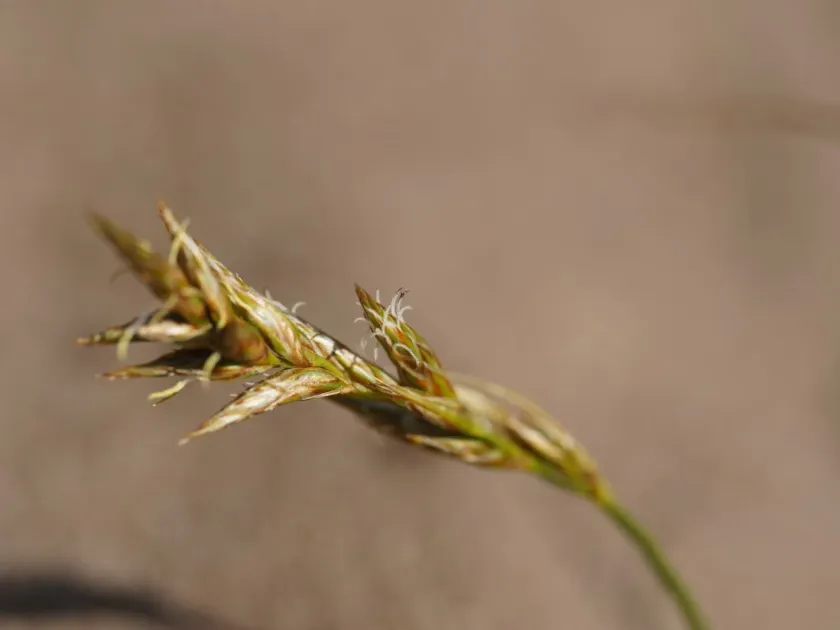
The inflorescence consists of a spike-like panicle. Each spike contains both male and female flowers, which is a specific botanical feature of this species within the Carex genus.
Vegetative propagation is the primary method of colonization; small fragments of rhizomes broken off during soil tillage can easily sprout and establish new plants.
Where it grows
Sand sedge is primarily found in coastal dunes, sandy seashores, river banks, and in dry, sandy soils within forest ecosystems throughout Europe.
In agricultural settings, it frequently invades light, sandy soils. Due to its hardiness, it thrives in environments where competition from other weed species is limited.
It is a common pest in fields adjacent to natural sand deposits or coastal areas, from which it invades cultivated land through horizontal rhizome expansion.
The species is highly tolerant of saline conditions and low-nutrient environments, allowing it to colonize marginal lands that are often neglected in standard farming.
Its ability to stabilize loose soil makes it a dominant species in disturbed sandy areas, often forming dense, exclusive mats that suppress local flora.
Harm it causes
The primary damage caused by sand sedge is its intense competition with crops for water and mineral nutrients, especially in soils with low moisture retention.
The dense network of underground rhizomes forms a thick mat that physically hinders the root development of cultivated crops, leading to reduced growth and yield.
Mechanical tillage is severely complicated by the presence of sand sedge. Rhizomes easily clog cultivators and plows, affecting the precision and depth of soil preparation.
Sand sedge can serve as an alternative host for various plant pathogens and insect pests, increasing the disease pressure on adjacent crops in the rotation.
Because the weed is highly resilient, standard shallow cultivation often leads to fragmentation rather than destruction, essentially promoting further spread throughout the field.
How to control
A successful agronomic approach requires deep moldboard plowing combined with harrowing during dry periods to expose rhizome fragments to desiccation.
Implementing a fallow period with repeated light cultivation or disking is effective for exhausting the energy reserves stored within the extensive root system.
Chemical control usually involves the application of systemic non-selective herbicides, specifically glyphosate-based products, during the stage of active vegetative growth.
- The most effective application window is during the spring regrowth or post-harvest vegetative flush.
- Adding surfactants to the tank mixture helps the active ingredient penetrate the tough, waxy leaves of the sedge.
- Avoid immediate mechanical disturbance after herbicide application to ensure the chemical reaches the deep rhizomes.
Integrated weed management, including competitive crop rotation and well-timed mechanical disturbance, is essential for long-term reduction of sand sedge populations.
Taxonomy
- Latin name
- Carex arenaria
- Family
- Осоковые
- EPPO code
- CRXAR