
Polanisia trachysperma
Polanisia trachysperma
Description
How to tell it apart
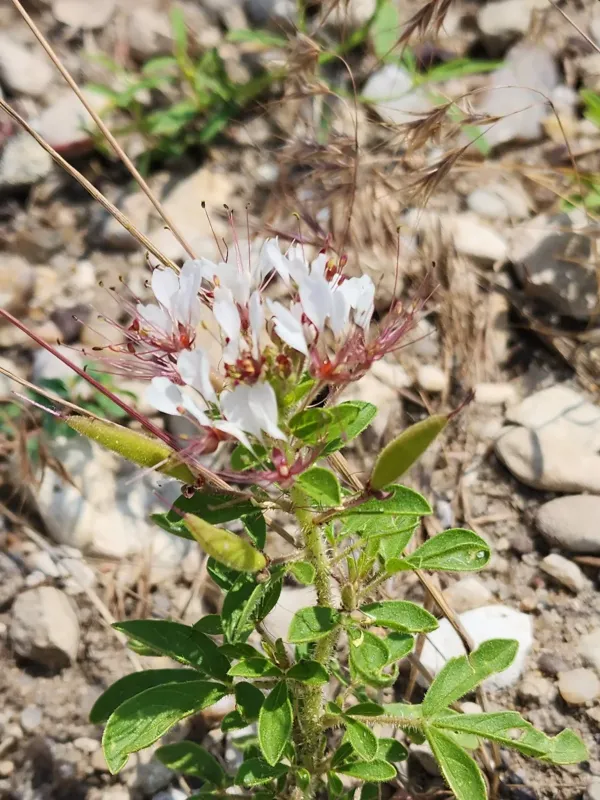
Polanisia trachysperma, commonly known as clammyweed, belongs to the Capparaceae family. It is an annual herbaceous plant easily recognized by its sticky, glandular-pubescent stems, which give it a distinct appearance and a strong, somewhat pungent odor.
The leaves are palmately compound, typically consisting of three leaflets that are lanceolate or elliptic in shape. The plant's structure allows it to adapt efficiently to dry, sandy soils where it often thrives in competition with other flora.
The flowers are arranged in terminal racemes, featuring four white to pale pink petals and prominent, long-exerted stamens. These flowers provide a clear identifying feature during the blooming period, which usually occurs throughout the summer months.
The fruit develops into a long, pod-like capsule that splits open when mature to release numerous seeds. These seeds are characterized by a rough, textured surface, explaining the species name trachysperma, which is a key marker for botanical identification.
With a robust taproot system, the plant can access deep soil moisture, which supports its growth even in harsh environmental conditions. Its life cycle is purely annual, relying entirely on heavy seed production to ensure its presence in the soil seed bank.
##habitat##Polanisia trachysperma is primarily native to North America, where it prefers sandy or gravelly habitats. It is commonly found in disturbed areas, such as roadsides, sandy riverbanks, and waste grounds, from where it easily migrates to agricultural fields.
In agricultural settings, this weed is a major concern for row crops such as corn, soybeans, and sorghum. It is particularly invasive in fields with lighter soil textures, where competition for available water is most intense.
The rapid spread of this species is often accelerated by farming activities. Agricultural machinery, particularly tractors and harvesters, can pick up seeds from infested areas and redistribute them across clean fields, exacerbating the problem each season.
Clammyweed is highly tolerant to heat and drought, allowing it to colonize fields that may be too dry for some traditional crops. This resilience makes it a persistent issue in arid or semi-arid agricultural regions.
The weed also thrives in non-cropped areas bordering fields, such as irrigation ditches and fence lines. These areas serve as a reservoir for the weed, allowing it to re-infest cultivated land following any successful eradication efforts.
Harm it causes
The primary harm caused by clammyweed is its aggressive competition with crops for limited moisture and nutrients. Because it can survive in nutrient-poor soils, it often starves the primary crop of the resources needed for maximum yield.
Research suggests that Polanisia trachysperma exhibits allelopathic properties, meaning it releases chemical compounds into the soil that can inhibit the germination and growth of neighboring crops, leading to uneven stand density.
The physical presence of the weed in dense patches creates a micro-environment that can harbor crop pests and diseases. The increased humidity within these patches often makes it difficult to apply foliar pesticides effectively to the crop itself.
Harvesting efficiency is severely impacted by the presence of this weed. Its tough, fibrous stems can clog machinery, leading to increased maintenance costs, downtime during peak harvest periods, and mechanical grain losses.
Seed contamination is another major economic factor. If clammyweed seeds are harvested along with the crop, they increase the amount of foreign matter, potentially leading to quality downgrading and penalties at grain receiving stations.
How to control
Effective control of clammyweed requires an integrated approach starting with crop rotation. Alternating competitive crops with different growth patterns helps disrupt the weed’s life cycle and prevents it from building up a large seed bank.
Mechanical cultivation remains a cornerstone of management. Tilling the soil before the weed sets seed is essential for keeping the population in check. Deep burial of seeds through moldboard plowing can also prevent them from successfully germinating.
In row crops, precise between-row cultivation is highly effective. Cultivating at the right time—before the plant develops deep roots—ensures that the seedlings are removed and the soil surface is disturbed, limiting further emergence.
Chemical control involving post-emergence herbicides is often necessary for severe infestations. The choice of herbicide must be carefully selected based on the specific crop safety and the growth stage of the clammyweed.
- Regular monitoring of field borders to prevent encroachment.
- Sanitizing equipment between fields to avoid transporting seeds.
- Maintaining high soil fertility to boost crop competitive ability.
- Applying herbicides at the sensitive seedling stage of the weed.
Taxonomy
- Latin name
- Polanisia trachysperma
- Family
- Клеома
- EPPO code
- PONTR