
Cleome viscosa
Cleome viscosa
Description
How to tell it apart
Cleome viscosa, commonly known as sticky cleome or Asian spiderflower, belongs to the Capparaceae family. It is an annual herbaceous plant reaching a height of 30 to 100 cm.
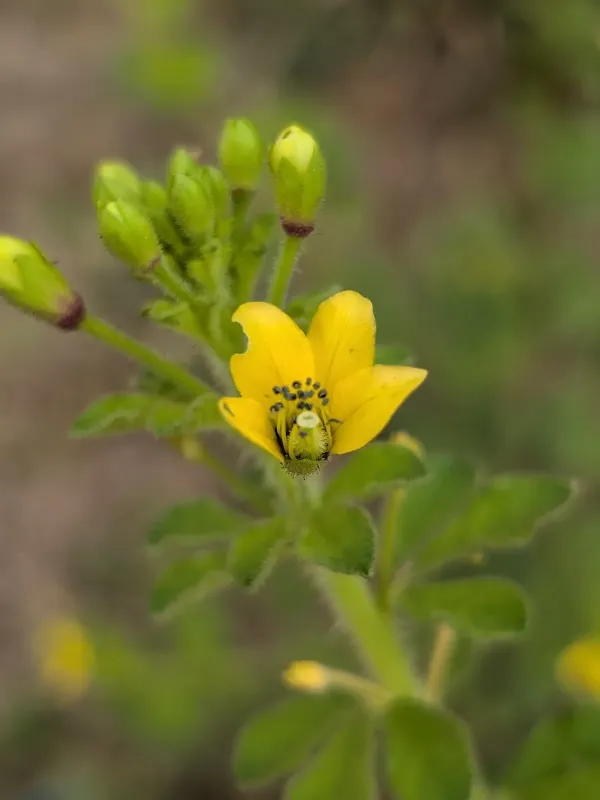
The stem is erect and branched, covered with glandular hairs that make the plant feel sticky to the touch, which is the primary characteristic for its identification.
Its leaves are alternate and trifoliate, emitting a distinct, pungent, mustard-like or herbal odor when crushed or handled.
The flowers are small, yellow, and arranged in loose racemes at the ends of the stems. The fruit is a long, narrow, capsule-like pod filled with small, dark seeds.
It possesses a strong, well-developed taproot system, which allows the plant to thrive even in arid conditions by accessing moisture from deeper soil layers.
Where it grows
This weed is widespread throughout tropical and subtropical regions of the world, commonly found in Asia, Africa, and Australia.
Cleome viscosa prefers open areas with disturbed soil, such as roadsides, wastelands, riverbanks, and recently cultivated fields.
In agricultural settings, it frequently invades row crops, cereals, and vegetable farms, particularly in irrigated agricultural systems.
The plant exhibits high adaptability to various soil types, including sandy, loamy, and rocky soils, and shows resilience to short-term water scarcity.
During warm seasons, the plant spreads rapidly via prolific seed production, quickly colonizing fallow lands and transitioning into neighboring crop fields.
Harm it causes
The primary harm caused by Cleome viscosa is its intense competition with crops for essential mineral nutrients, soil moisture, and sunlight.
The weed acts as an alternative host for various agricultural pests, such as aphids, and can facilitate the transmission of viral diseases to vegetable crops.
The glandular hairs and sticky secretions make the plant a nuisance during harvesting operations, as it can clog the intake and cutting mechanisms of agricultural machinery.
Heavy infestations of the weed significantly reduce yields in cereal and legume fields because the root system depletes the topsoil of fertility.
Contamination of commercial grain with Cleome seeds necessitates costly cleaning and sorting processes, which negatively affects the final market value of the harvest.
How to control
An effective agronomic control method is the rigorous implementation of crop rotation, which helps prevent the accumulation of a persistent seed bank in the soil.
Deep autumn plowing is a recommended strategy to bury seeds deep enough to prevent germination, effectively reducing the weed population in the following season.
Frequent inter-row cultivation during the early stages of crop development is essential to uproot young Cleome plants before they reach the flowering stage.
Chemical control involves the use of selective herbicides, which are most effective when applied at the very early growth stages, specifically the cotyledon or seedling phase.
In regions with high weed pressure, integrated management is recommended, combining soil-applied herbicides before planting and post-emergence treatments as needed.
Taxonomy
- Latin name
- Cleome viscosa
- Family
- Клеома
- EPPO code
- CLEVI