
Greater chickweed
Stellaria neglecta
Description
How to tell it apart
Greater chickweed (Stellaria neglecta) is an annual herbaceous plant belonging to the Caryophyllaceae family. It is often mistaken for the common chickweed but is distinct in its physical dimensions.
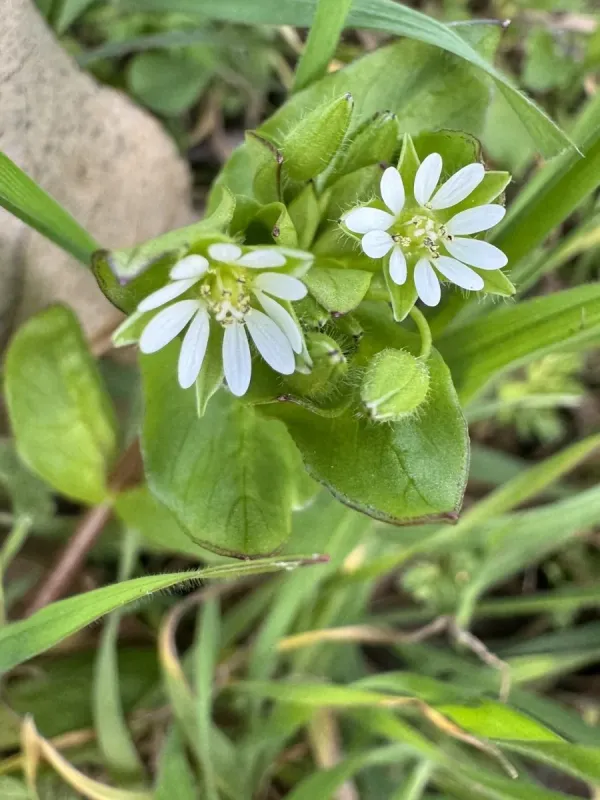
The stems are branched, ascending, or procumbent, reaching heights up to 60 cm. The plant typically features glandular hairs on its upper parts, which is a key diagnostic characteristic.
Leaves are ovate-cordate, with the lower ones being petiolate and the upper ones sessile. This arrangement allows the plant to maximize light interception even in low-density conditions.
Flowers are white with five deeply bifid petals. The seed capsules are significantly larger than those of common chickweed, providing a higher reproductive potential per plant.
The root system is fibrous and shallow, adapted to exploit nutrient-rich topsoil efficiently, which makes it a persistent weed in well-manured agricultural fields.
Where it grows
This weed favors moist, fertile, and nitrogen-rich soils. It is frequently found in gardens, orchards, and intensive crop fields where irrigation is provided regularly.
Greater chickweed is particularly troublesome in winter cereal crops, as it can establish itself during autumn and compete for resources as soon as temperatures rise in early spring.
Vegetable crops such as potatoes and brassicas are highly susceptible to infestation, where the high moisture levels maintained for crops support the weed's vigorous growth.
It also colonizes waste grounds, field margins, and ditches. These areas act as reservoirs that allow the weed to spread through seeds carried by agricultural equipment or run-off water.
The plant demonstrates a high degree of adaptability to shady environments, allowing it to survive under the canopy of established crops, which complicates manual weeding efforts.
Harm it causes
The primary harm caused by Greater chickweed is aggressive competition for water and soil nutrients, which stunts the development of young seedlings in the early growth stages.
By creating a dense mat of vegetation, the weed raises local humidity levels, which significantly increases the risk of fungal pathogens infecting the crop foliage.
Greater chickweed serves as an alternative host for several crop pests and viruses, enabling them to survive in the field between growing seasons of the primary crop.
Mechanical harvesting becomes inefficient when the field is heavily infested, as the tangled weed biomass interferes with machinery and increases the moisture content of the harvested grain.
Significant yield losses occur in dense infestations, where the weed shades out the crop and depletes the topsoil of nitrogen, phosphorus, and potassium.
How to control
Cultural control involves deep plowing (tillage) to bury seeds, as this species prefers surface or shallow germination; burying seeds deep prevents successful emergence.
Implementing a diverse crop rotation is essential to prevent the build-up of the seed bank. Including crops with competitive growth habits can suppress chickweed development.
Mechanical operations, such as harrowing and hoeing during the early seedling phase, provide effective control by uprooting the shallow root system before it becomes established.
Chemical control is highly effective using systemic herbicides. It is crucial to apply these treatments early, as older, mature plants develop higher tolerance to chemical stressors.
- Apply selective herbicides compliant with specific crop safety guidelines.
- Ensure equipment is cleaned thoroughly to prevent the transfer of seeds between fields.
- Maintain buffer zones around fields by mowing to reduce the immediate seed pressure.
Taxonomy
- Latin name
- Stellaria neglecta
- Family
- Гвоздичные
- EPPO code
- STENE