
Long-stalk starwort
Stellaria longipes
Description
How to tell it apart
Long-stalk starwort (Stellaria longipes) is a perennial herbaceous plant belonging to the Caryophyllaceae family. This species exhibits significant morphological variability, making it sometimes challenging to distinguish from closely related species in the field.
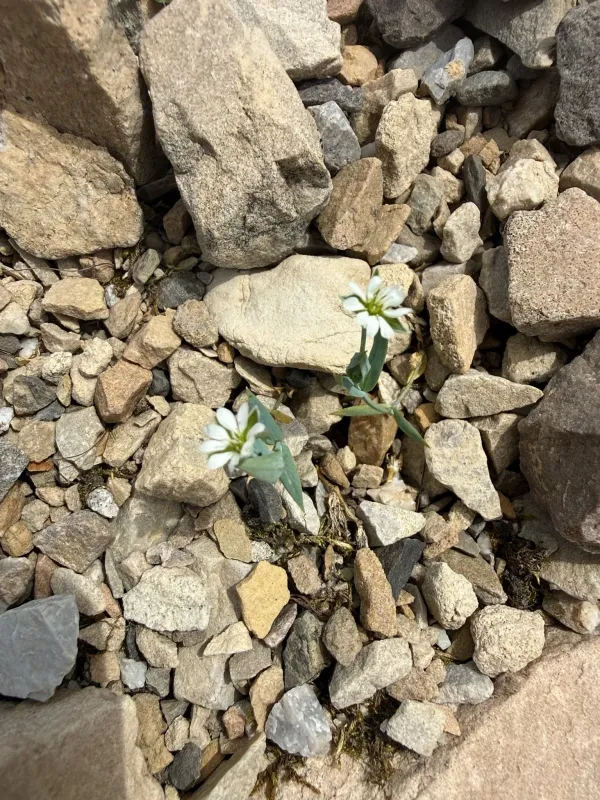
The primary identifying feature is the narrow, lanceolate or linear leaves that are arranged in opposite pairs along the stem. The stems can be ascending or erect, branching at the base to form dense mats or clusters.
The flowers have white petals that are deeply cleft, appearing as though there are ten petals instead of the typical five. The anthers often have a yellowish or reddish tint, which is a key diagnostic character during the flowering season.
The root system is comprised of delicate but persistent rhizomes, allowing the plant to spread vegetatively and survive in diverse environmental conditions, including harsh climates.
Unlike some other members of the genus, Stellaria longipes is highly adapted to cooler, temperate, and arctic-alpine environments, which influences its growth cycle and internode length.
Where it grows
This weed typically prefers moist, well-lit habitats, including riverbanks, riparian zones, and disturbed areas. It thrives in soils with adequate moisture but can also colonize semi-arid regions if local humidity levels are sufficient.
In agroecosystems, it is often found in grain fields and cultivated land, especially in regions with cool, wet springs. It frequently establishes along field edges, ditch banks, and boundary strips.
The plant adapts well to various soil types, ranging from sandy loams to heavier clay soils, provided that there is a sufficient supply of water during the growing season.
It is capable of colonizing land quickly after soil disturbance, making it a persistent weed in fields where minimum tillage practices are employed without adequate herbicide programs.
Its natural range includes various meadow and tundra communities, demonstrating its extreme ecological plasticity and ability to outcompete native vegetation in disturbed spots.
Harm it causes
The primary harm caused by Long-stalk starwort is competition with crops for light, soil moisture, and nutrients, particularly during the early vegetative stages of the crop.
Dense mats of this weed can create a localized microclimate with higher humidity near the soil surface, which increases the risk of fungal infections and other crop diseases.
During harvest, the presence of these weeds can contaminate the grain yield, increasing the moisture content of the harvested product and requiring extra energy for drying and cleaning.
Furthermore, Stellaria longipes serves as an alternative host for several crop pests and pathogens, facilitating their survival during off-seasons and their spread into commercial fields.
Severe infestations can lead to significant yield losses, as the weed's ability to propagate vegetatively makes it difficult to eradicate once it has established a foothold in the field.
How to control
Management of Long-stalk starwort requires an integrated approach that combines cultural, mechanical, and chemical control strategies to exhaust the plant's rhizome reserves.
Mechanical control involves deep primary tillage, such as plowing, which serves to disrupt and dry out the rhizomes. Repeated cultivation is often necessary to weaken the weed's regenerative capacity.
Chemical control focuses on the use of systemic herbicides applied during active growth stages. These treatments are most effective when the plant is in the vegetative or early bolting stage.
Crop rotation remains a fundamental practice, as it disrupts the growth cycle of the weed and allows for the application of different herbicide modes of action in subsequent seasons.
- Applying systemic herbicides during the autumn fallow period to target rhizomes.
- Using competitive crop varieties that canopy quickly to shade out the weed.
- Implementing regular mechanical weeding in row crops to disrupt mat formation.
- Ensuring the use of certified, weed-free seed to prevent the introduction of propagules.
Taxonomy
- Latin name
- Stellaria longipes
- Family
- Гвоздичные
- EPPO code
- STELA