
Tundra chickweed
Stellaria crassipes
Description
How to tell it apart
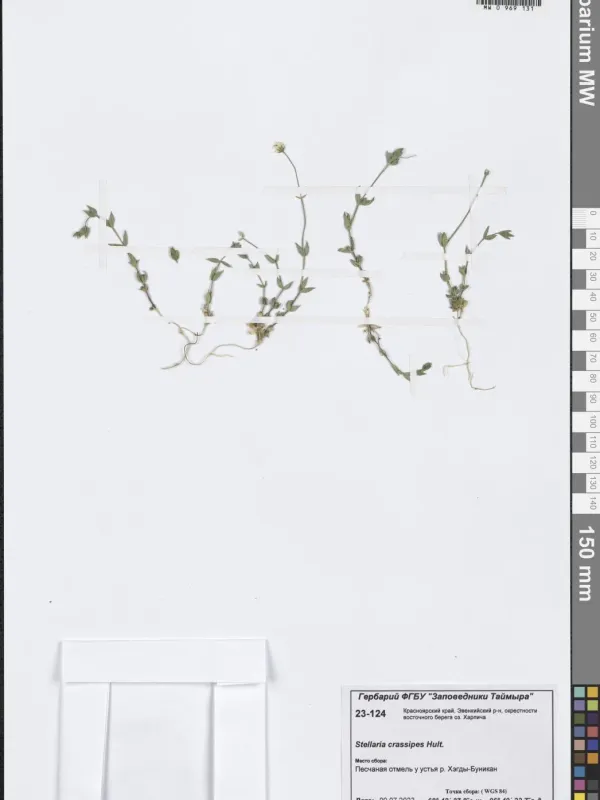
Tundra chickweed (Stellaria crassipes) is a herbaceous plant belonging to the Caryophyllaceae family. It closely resembles other species of the genus Stellaria but is distinguished by its fleshy, thickened leaves and stems, a feature that inspired its scientific name.
The plant possesses a specific morphology adapted to survive in harsh Arctic climates. It features a developed root system and characteristic small white flowers with deeply cleft petals, which are typical for members of the Stellaria genus.
The vegetative organs of the plant show high plasticity. The stems are often creeping or ascending, allowing the weed to form dense mats that hinder the development of crops during the early stages of the growing season.
Botanically, tundra chickweed is classified as a perennial herb. Its ability to propagate vegetatively makes it a significant competitor for resources in shaded or damp agricultural areas.
Identification is often challenging because, in northern latitudes, it can easily cross-pollinate or exist in mixed communities with other chickweed species. Precise determination requires examining the shape of the sepals and the hairiness of the pedicels.
Where it grows
Tundra chickweed is an Arctic species whose distribution covers the northern regions of Canada, Greenland, Norway, Sweden, and the northern territories of Russia. It is a typical inhabitant of the tundra zone.
In agricultural practice, it is found mainly in regions with extremely low temperatures where limited farming is conducted. It prefers moist, well-drained soils with high organic matter content.
The plant frequently colonizes perennial grass fields, pastures, and forage lands in northern latitudes. Its presence in cereal crops in these regions reduces overall land productivity.
The weed also actively occupies the edges of drainage ditches, roadsides, and fallow lands, from where its seeds are dispersed by wind and water into cultivated fields.
Its resistance to frost allows this weed to begin active growth as soon as the snow melts, outcompeting many agricultural crops and significantly complicating early spring field operations.
Harm it causes
The primary damage caused by tundra chickweed lies in its ability to suppress crop plants during initial growth phases. By competing for light, moisture, and nutrients, it significantly reduces crop density.
In perennial grass crops, this weed reduces the nutritional value of hay. Due to its similarity to other chickweed species, it can contaminate seed stock, making it difficult to maintain high-quality seed supplies.
A specific biological feature of the species—the ability to form a continuous carpet—promotes water stagnation in the soil and the development of fungal infections in the root zones of cultivated plants.
In northern agriculture, it contributes to the depletion of soil nitrogen reserves, which are critical for yield formation during the very short growing season.
The presence of this weed requires additional costs for crop cleaning after harvest, as the moist, succulent stems of the chickweed can clog the working components of agricultural machinery.
How to control
Mechanical control of tundra chickweed involves systematic deep soil cultivation, which cuts the root system and leads to the desiccation of the above-ground parts of the weed.
An effective agronomic practice is the use of crop rotation with species that have a dense canopy, as they create natural shade that suppresses the growth of this light-loving weed.
The application of systemic herbicides is recommended during the active growth phase of the weed before it begins to flower. The choice of products must account for the specific temperature regimes typical of northern agriculture.
Clearing surrounding areas (roadsides and field boundaries) from seed source hotspots is a critical preventive measure to stop the re-infestation of cultivated fields.
- Regular harrowing of seedling emergence.
- Timely mowing of field edges and boundaries.
- Use of high-quality certified planting material.
- Adherence to recommended mineral fertilizer rates to stimulate crop growth.
Taxonomy
- Latin name
- Stellaria crassipes
- Family
- Гвоздичные
- EPPO code
- STECR