
Small-flowered catchfly
Silene gallica
Description
How to tell it apart
The small-flowered catchfly (Silene gallica) is an annual herbaceous plant belonging to the Caryophyllaceae family and is commonly classified as a spring or winter weed.
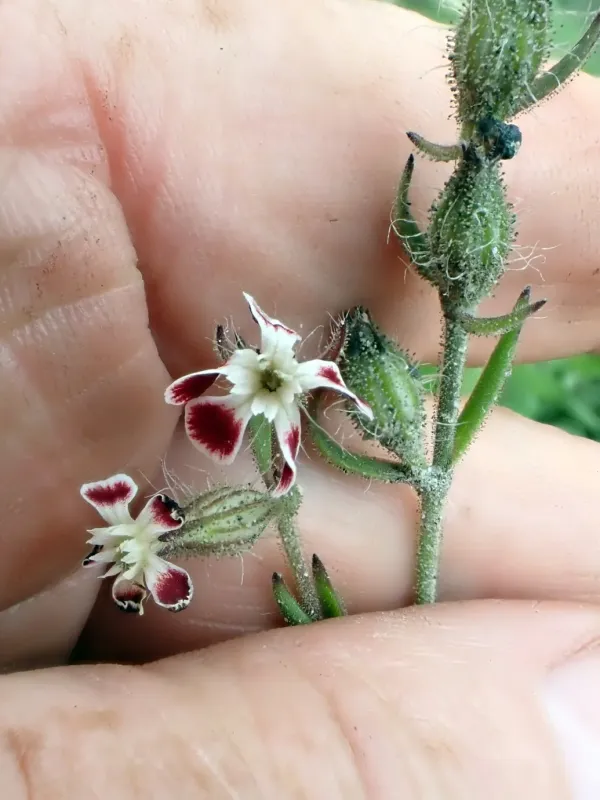
The plant typically grows 15 to 45 cm tall, featuring an erect stem that is often covered in glandular hairs, which give the plant a sticky texture when handled.
Its leaves are arranged in opposite pairs: basal leaves are spatulate or oblanceolate, while stem leaves are narrower, sessile, and lanceolate in shape.
Flowers form in one-sided leafy racemes. The petals are white to pinkish, sometimes with colored spots, and are characterized by a deep notch at the apex.
The fruit is a multi-seeded capsule that splits into teeth at maturity to release numerous small, brownish seeds into the surrounding environment.
Where it grows
This weed species prefers light-textured soils such as sandy or loamy soils and is frequently found in areas with disturbed soil surfaces or open landscapes.
Silene gallica often infests winter cereal fields, vegetable farms, vineyards, and young orchards where sunlight is abundant and competition is relatively low.
Native to regions with mild climates, including the Mediterranean and parts of Western Europe, it has been introduced globally to various temperate zones.
The species is commonly found along roadsides, in wasteland areas, and on field margins, from where it easily migrates into productive agricultural land.
It exhibits a degree of drought tolerance, allowing it to survive in arid conditions and persist in crops where water management is inconsistent.
Harm it causes
The primary damage caused by Silene gallica is its aggressive competition with cultivated crops for essential nutrients, soil moisture, and light resources.
High densities of this weed in cereal crops can severely limit the growth of main plants, leading to significant reductions in biomass and final grain yield.
The sticky glandular hairs on the plant's surface can collect dust and debris, potentially interfering with field operations and creating a niche for pests.
Contamination of harvested grain with the seeds of the small-flowered catchfly downgrades product quality and poses a risk of spreading the weed to clean areas.
Its presence at harvest time can complicate mechanical harvesting processes, leading to increased moisture content in stored grains and higher operational costs.
How to control
Long-term control relies on integrated crop management, including diverse crop rotations that interrupt the life cycle of the weed and reduce the soil seed bank.
Standard agronomic practices such as deep moldboard plowing and thorough seedbed preparation help bury seeds at depths that prevent successful germination.
Inter-row cultivation during the early stages of crop development is highly effective in managing this weed, particularly in wide-spaced row crops.
Chemical control involves the application of selective herbicides in the early post-emergence phase, targeting broad-leaved weeds according to local guidelines.
- Ensuring the use of clean, certified crop seeds free from weed contamination.
- Cleaning harvesting machinery between fields to prevent the dispersal of seeds.
- Mowing field perimeters and non-crop areas before the weed reaches the flowering stage to stop seed production.
Taxonomy
- Latin name
- Silene gallica
- Family
- Гвоздичные
- EPPO code
- SILGA