
Water chickweed
Myosoton aquaticum
Description
How to tell it apart
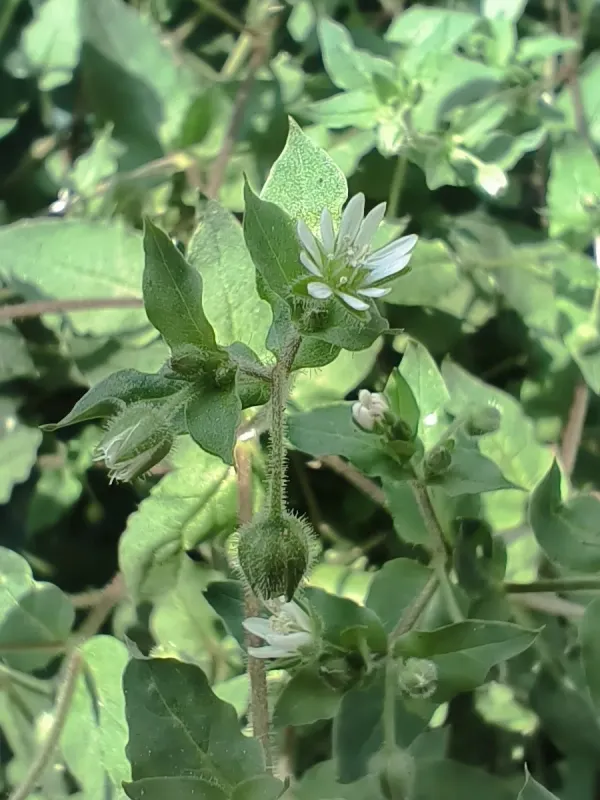
Water chickweed (Myosoton aquaticum) is a perennial or annual weed belonging to the Caryophyllaceae family. It is easily identified by its sprawling, reclining stems that can grow up to 60 cm in length.
The leaves are heart-shaped or ovate, and the stems are covered with fine glandular hairs, which give the plant a characteristic soft, sticky texture when touched.
It produces small white flowers with deeply divided petals, often appearing as if there are ten petals instead of five. The plant is prolific, capable of producing thousands of seeds in a single season.
The root system is fibrous and fragile, but the plant is highly capable of vegetative propagation. Stems that come into contact with moist soil can quickly root, forming new plantlets.
Botanically, it is a moisture-loving species that thrives in damp, nutrient-rich environments, often colonizing fields where water management is suboptimal.
Where it grows
This weed is commonly found in temperate regions, specifically favoring areas with high soil moisture. It is frequently observed along stream banks, ditches, and wetlands.
In agricultural settings, water chickweed is a major concern in irrigated crops. It thrives in vegetable gardens, sugar beet fields, and areas where overhead irrigation keeps the surface soil consistently damp.
It prefers fertile soils rich in nitrogen. It is rarely found in dry, sandy, or poorly fertilized soils, which makes it an indicator species for nitrogen-rich, moist ground.
The plant often spreads from drainage canals and field borders, where it remains undisturbed, into cultivated fields during wet seasons or flood events.
Its ability to tolerate partial shade allows it to grow effectively under the canopy of broad-leaved crops, where it remains protected from direct mechanical weeding.
Harm it causes
Water chickweed acts as a significant competitor for nutrients, effectively "stealing" nitrogen meant for crop development. This results in reduced vigor and stunted growth of the main crop.
The weed forms dense mats that blanket the soil surface, preventing proper air circulation and keeping the microclimate around the base of the crop overly humid, which promotes rot.
By competing for sunlight and nutrients in the early growth stages, the weed can significantly delay the development of seedlings, often leading to yield losses in row crops.
It serves as an alternative host for various pests and pathogens, including viruses that can be transmitted to cash crops by aphids or other insects residing on the weeds.
During harvest, high infestation levels increase the moisture content of the grain or produce, complicating processing and drying requirements and causing equipment downtime.
How to control
Improving field drainage is the most effective long-term preventative measure. Reducing stagnant water discourages the weed from establishing a permanent foothold.
Mechanical control involves early-season inter-row cultivation. Since the plant can re-root easily, it is crucial to ensure that uprooted weeds are fully exposed to dry air to prevent regrowth.
Chemical control relies on systemic herbicides. Because the weed is broad-leaved, standard 2,4-D or other selective herbicides are often effective depending on the crop species.
Crop rotation remains a fundamental strategy. Alternating between crops that allow for intense mechanical weeding and those that shade the soil heavily can reduce seed bank survival.
- Maintain weed-free boundaries around irrigation ditches.
- Use certified, clean seeds to prevent weed introduction.
- Implement timely herbicide application during the seedling stage.
Taxonomy
- Latin name
- Myosoton aquaticum
- Family
- Гвоздичные
- EPPO code
- MYTAQ