
Upright chickweed
Moenchia erecta
Description
How to tell it apart
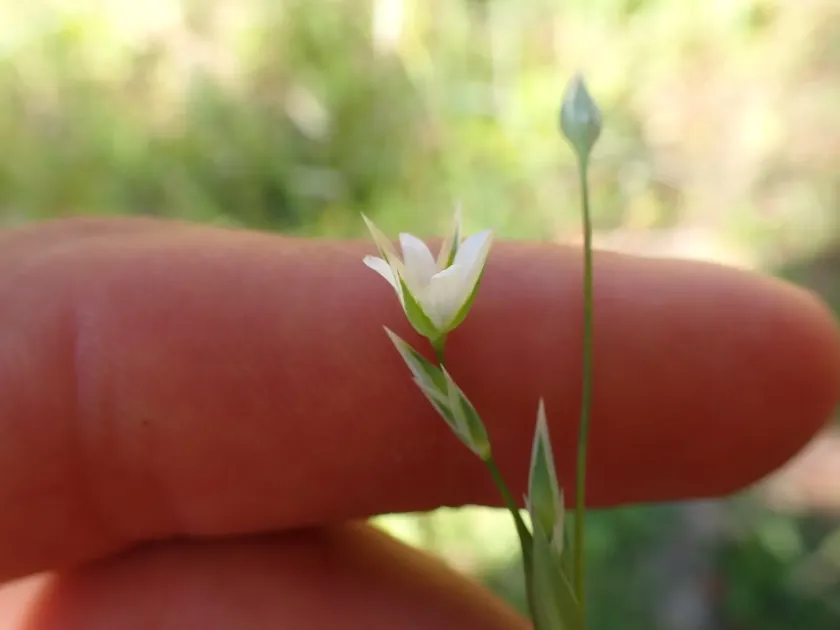
Upright chickweed belongs to the Caryophyllaceae family and is a small annual herbaceous plant. It typically reaches 2 to 15 centimeters in height, featuring upright or ascending stems that often branch from the base.
The leaves are linear-lanceolate, opposite, sessile, and often exhibit a glaucous-green color, which is a key identification feature. Basal leaves usually form a rosette that may wither as the plant matures.
The flowers are arranged in loose inflorescences with white petals that are usually shorter than the sepals. The calyx consists of four sepals with membranous margins, which is critical for taxonomic identification.
The root system is fibrous and poorly developed, making the plant susceptible to mechanical soil disturbance during the early growth stages. The fruit is a capsule that splits into teeth upon maturity.
As an ephemeral species, it completes its life cycle within a short period in early spring, often making it difficult to detect until the flowering phase begins.
Where it grows
Upright chickweed prefers open, sunny habitats with light, sandy, or loamy soils and is frequently found in acidic soil environments.
Common habitats include pastures, waste grounds, dry meadows, road verges, and field margins where the natural ground cover has been disturbed.
In agricultural settings, this weed is most frequently encountered in winter cereal fields and perennial grass crops, where it exploits available space during early spring.
The plant is adapted to temperate climates across Europe and spreads primarily via seeds dispersed by wind and agricultural machinery.
Its high competitiveness is most evident in sparse crop stands, where it rapidly occupies available ecological niches before the main crop reaches full canopy closure.
Harm it causes
The primary damage caused by upright chickweed is the uptake of essential soil nutrients and moisture during critical early development stages of crops.
While it does not create significant shading due to its small size, high-density infestations can notably reduce the yield and productivity of winter crops.
The weed acts as a potential reservoir for various pests and pathogens that may migrate to cultivated plants within the Caryophyllaceae family.
The presence of this weed necessitates additional agricultural operations and can complicate harvesting processes if the infestation is widespread.
Contamination of harvested seeds with upright chickweed seeds degrades crop quality, which is especially detrimental to seed production operations.
How to control
Effective management of upright chickweed begins with high-quality primary soil tillage, such as deep plowing, which buries seeds deep enough to prevent successful germination.
Crop rotation is an essential agronomic practice that prevents the long-term buildup of the weed seed bank in the soil horizon.
During the vegetative growth phase, inter-row cultivation and harrowing are highly effective at destroying young weed seedlings before they reach the flowering stage.
Chemical control can be achieved using broad-spectrum herbicides, provided that their application is authorized and effective for the specific crop variety during the weed's early growth.
Recommended management strategies:
- Deep autumn plowing to inhibit early spring emergence.
- Timely spring soil cultivation prior to sowing.
- Use of certified, high-purity planting material.
- Application of systemic herbicides during early growth phases.
Taxonomy
- Latin name
- Moenchia erecta
- Family
- Гвоздичные
- EPPO code
- MOEER