
Holosteum umbellatum
Holosteum umbellatum
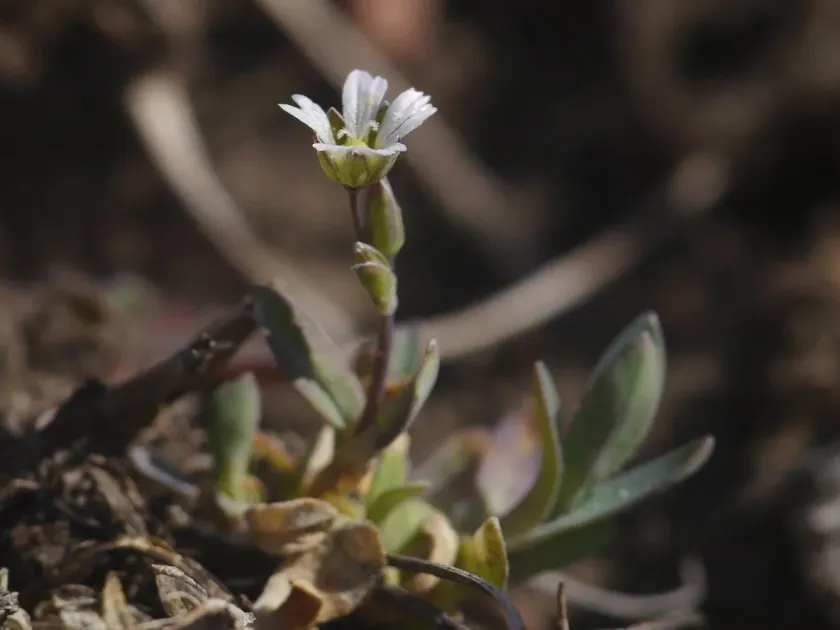
Description
How to tell it apart
Holosteum umbellatum, commonly known as jagged chickweed, is a small winter annual plant belonging to the Caryophyllaceae family.
The plant typically grows to a height of 5 to 20 centimeters, characterized by a slender, branched stem that is often glaucous or slightly pubescent.
Its leaves are arranged oppositely along the stem, with the basal ones being spatulate and the upper ones becoming more lanceolate in shape.
The most distinctive feature is the umbel-like inflorescence located at the top of the stem, producing small white flowers with five notched petals.
It possesses a shallow taproot system, allowing it to establish quickly in the early spring, often ahead of many major agricultural crops.
Where it grows
This weed is widely distributed in temperate regions, preferring well-lit environments and sandy or light-textured soil types.
It is frequently observed in winter wheat and barley fields, as its life cycle perfectly aligns with the autumn germination and spring development of these crops.
Beyond agricultural lands, jagged chickweed thrives in fallow fields, along roadsides, and in disturbed areas where it can propagate undisturbed.
The species exhibits high ecological plasticity, allowing it to colonize diverse environments, from highly managed farms to neglected areas.
Minimal tillage systems are particularly conducive to the persistence of Holosteum umbellatum, as surface residue protects seeds and aids in early germination.
Harm it causes
Jagged chickweed causes significant harm by competing with winter crops for essential nutrients and soil moisture during the critical early spring growth phase.
By forming dense patches, it shades the soil surface, which interferes with proper soil temperature regulation and microbial activity essential for crop health.
The weed acts as a primary competitor that reduces the availability of nitrogen, leading to stunted growth and reduced tiller numbers in cereal crops.
It can also harbor various pests and diseases that may subsequently migrate to the main crop, necessitating additional integrated pest management efforts.
High infestation levels in a field can lead to significant yield losses, as the energy that should be dedicated to crop biomass is diverted to the weed.
How to control
The most effective strategy for managing Holosteum umbellatum is an integrated approach combining mechanical, chemical, and cultural practices.
Cultural control involves implementing crop rotations that disrupt the life cycle of the weed and maintaining a competitive crop stand.
Mechanical operations, such as early spring harrowing, are highly effective in uprooting the shallow-rooted plants before they cause significant damage.
Chemical control focuses on the use of selective herbicides, particularly those labeled for use in cereal crops to target early-growth weeds.
- Utilizing certified seed to prevent field contamination.
- Applying herbicides during the early stages of weed development.
- Ensuring proper nutrient management to promote crop vigor.
- Monitoring fields periodically throughout the spring season.
Taxonomy
- Latin name
- Holosteum umbellatum
- Family
- Гвоздичные
- EPPO code
- HLOUM