
Drymaria cordata
Drymaria cordata
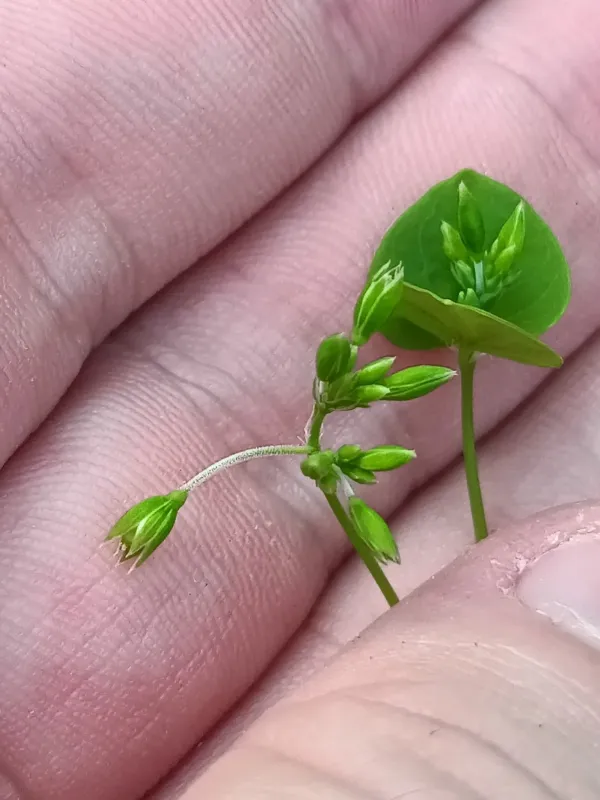
Description
How to tell it apart
Drymaria cordata, commonly known as tropical chickweed, is an annual herbaceous plant belonging to the Caryophyllaceae family. It is often misidentified in the field due to its morphological resemblance to common chickweed (Stellaria media).
The plant features sprawling, branched stems that are capable of rooting at the nodes, allowing it to spread rapidly across the soil surface and form dense mats.
Its leaves are opposite, heart-shaped with smooth edges, and possess distinctive glandular hairs. These hairs are a key identification feature distinguishing it from other similar species.
The flowers are small, white, and arranged in loose clusters. It produces numerous seeds in small capsules, contributing to its aggressive propagation potential and long-term soil seed bank viability.
The root system is primarily shallow but efficient, enabling the plant to establish quickly in moist environments and compete effectively with crop seedlings for space and resources.
Where it grows
Drymaria cordata favors moist, shaded environments. It is highly invasive in tropical and subtropical regions, often colonizing disturbed soils and areas with high humidity levels.
It is a significant nuisance in perennial plantations, including tea, coffee, and cocoa, where shaded conditions and regular moisture create an optimal habitat for its proliferation.
In row crops, it rapidly infests space between rows, particularly under irrigation systems or following heavy rainfall, which creates the damp conditions the weed thrives in.
The plant is frequently found along roadsides, near water bodies, and on abandoned farmland, acting as a reservoir for seed dispersal into adjacent productive agricultural fields.
While adaptable to various soil types, it shows a preference for nutrient-rich loams and organic soils with neutral to slightly acidic pH levels.
Harm it causes
The primary damage caused by Drymaria cordata is its competitive dominance; its mat-forming habit chokes out crop seedlings, depriving them of essential sunlight and space during early development.
As a vigorous water consumer, the weed rapidly depletes soil moisture, putting the main crop under stress and potentially reducing overall yield during dry spells.
Drymaria cordata serves as an alternate host for several pathogens and pests, potentially facilitating the spread of diseases to economically important crops.
Mechanical control is difficult because the plant's ability to root at the nodes means that any small stem fragment left behind during weeding can easily regenerate.
In greenhouse operations, dense infestation increases humidity at the canopy level, creating a conducive environment for root rot and fungal infections, thereby impacting overall plant health.
How to control
Effective management begins with thorough seedbed preparation and deep plowing to bury seeds, which prevents them from germinating successfully during the growing season.
Crop rotation incorporating vigorous, fast-growing species that can shade out the soil is a recommended practice to naturally limit the weed's development.
Herbicide applications must be timed carefully according to the weed's growth stage, ideally targeting young, actively growing plants before they establish dense root systems.
- Frequent mechanical weeding between rows to disrupt nodal root establishment.
- Application of mulch in orchards to suppress light and prevent germination.
- Sanitation of field borders to stop the spread of seeds from external sources.
Chemical control often involves the use of systemic herbicides that can effectively penetrate the plant's tissue and destroy the rooting nodes to prevent vegetative regrowth.
Taxonomy
- Latin name
- Drymaria cordata
- Family
- Гвоздичные
- EPPO code
- DRYCO