
Cerastium uniflorum
Cerastium uniflorum
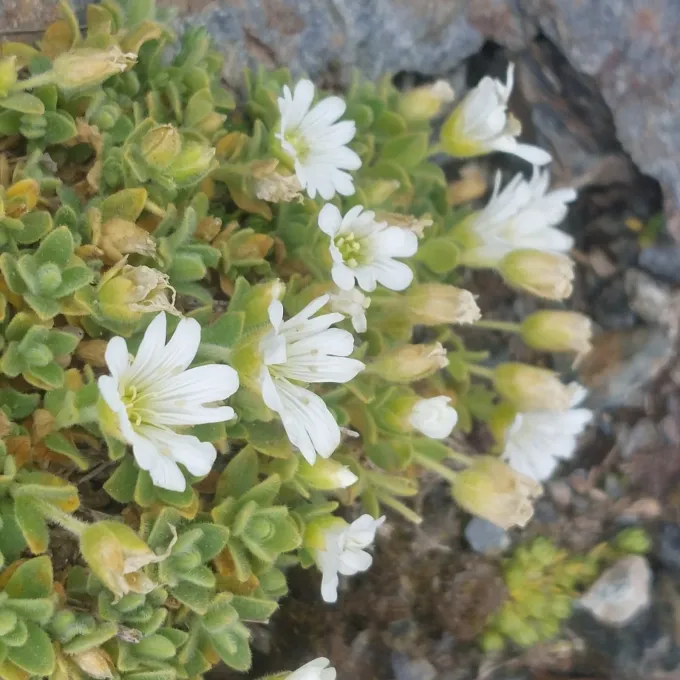
Description
How to tell it apart
Cerastium uniflorum, commonly known as a type of alpine mouse-ear chickweed, belongs to the Caryophyllaceae family. It is a perennial herbaceous plant with a prostrate or mat-forming growth habit.
The plant features opposite leaves, often densely covered in fine hairs, which provide protection against extreme mountain climates and moisture loss.
Its flowers are characteristically solitary, featuring a white corolla with five petals that are often deeply cleft at the apex, a key feature for botanical recognition.
The root system is fibrous and robust, allowing the plant to anchor effectively in rocky or nutrient-poor soils where other vegetation may struggle to establish.
It is classified as a perennial weed capable of spreading both through seed production and vegetative fragmentation of its stems, which can reroot easily.
Where it grows
This species is primarily adapted to alpine and subalpine zones, commonly found in rock crevices, scree slopes, and mountain meadows where it can survive harsh conditions.
In agricultural settings, it often invades fields located near mountainous or high-altitude regions, taking advantage of disturbed soil surfaces near the field edges.
It prefers cool, well-drained but moist environments and demonstrates a high tolerance for varying temperatures and low soil fertility levels.
The plant often colonizes fallow lands, perennial grasslands, and areas with limited tillage, gradually outcompeting native or desirable forage species.
Its ability to withstand frost and colonize eroded sites makes it a persistent weed in regions with specific agro-climatic conditions near mountain ranges.
Harm it causes
The primary damage caused by this weed is the suppression of crop seedlings through rapid colonization and competition for vital nutrients and space in the early growth stages.
By forming dense mats, the weed reduces light penetration to the soil surface, hindering the development of sensitive agricultural crops and reducing overall stand uniformity.
The presence of this weed creates a niche for specific plant pathogens and pests, potentially increasing the disease pressure within the primary crop field.
During harvest, the presence of these weeds can contaminate the grain, leading to higher processing costs and lower market quality of the final harvest products.
Economic losses are also incurred due to the necessity of intensive mechanical cultivation and the requirement for selective herbicide applications to clear the fields.
How to control
Agronomic control strategies include deep primary tillage, which is essential to disturb the root systems and prevent the plant from establishing a long-term colony.
Crop rotation incorporating vigorous, fast-growing cover crops can effectively shade out the weed, as it thrives in exposed and sparsely vegetated conditions.
Chemical management involves the use of systemic herbicides during the active growth phase, preferably before the plant reaches its full flowering and seeding maturity.
Mechanical management through regular weeding and shallow soil cultivation in inter-row spaces helps in preventing seed set and weakening the existing weed patches.
- Regular monitoring of field margins for early infestation.
- Post-harvest cultivation to destroy vegetative propagules.
- Application of selective herbicides during the rosette growth stage.
Taxonomy
- Latin name
- Cerastium uniflorum
- Family
- Гвоздичные
- EPPO code
- CERUN