
Little mouse-ear
Cerastium semidecandrum
Description
How to tell it apart
Little mouse-ear (Cerastium semidecandrum) is an annual herbaceous plant belonging to the Caryophyllaceae family and is classified as an early spring ephemeral.
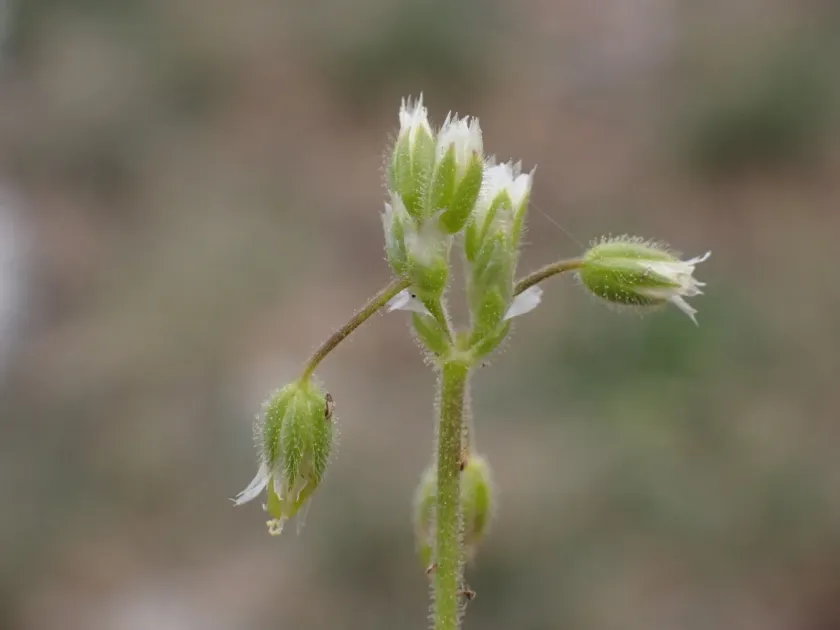
The plant has a straight or ascending stem reaching 5–15 cm in height, covered with glandular hairs that give it a characteristic sticky texture.
The leaves are opposite, oblong-ovate, with the lower ones narrowed into a short petiole, appearing in dense clusters during the early growth stage.
Small white flowers are arranged in loose cymes; the petals are deeply notched at the tip and often shorter than the sepals, which have a distinctive membranous margin.
The root system is a shallow taproot, allowing the plant to complete its lifecycle rapidly before the onset of drier summer weather conditions.
Where it grows
This weed prefers light sandy or loamy soils and is frequently found in fallow fields, pastures, roadsides, and open, dry agricultural landscapes.
In agriculture, it typically affects winter cereal crops, thriving where early spring soil moisture is available but competition from crops is not yet fully established.
The species is widespread throughout temperate regions, adapting well to various disturbed habitats where it can quickly establish its population.
It also appears in vegetable gardens and nursery fields, especially on sites left uncultivated during the early spring period.
Due to its short vegetative period, it successfully survives in areas with intensive soil management if the tillage operations are timed incorrectly.
Harm it causes
The primary damage is caused by the weed's competition for essential soil moisture and nutrients during the early spring development phase of crops.
Early colonization of crop fields by little mouse-ear can stunt the growth of young seedlings, leading to reduced stand uniformity and yield potential.
It serves as a reservoir for various plant pathogens and viruses, which can then spread to sensitive vegetable or cereal crops during the season.
High population densities interfere with light availability for young crops, negatively impacting early-stage plant development and photosynthetic efficiency.
The presence of fine weed seeds in the harvest complicates the post-harvest cleaning process and may reduce the market grade of the final product.
How to control
Effective management includes early spring harrowing to destroy weed seedlings before or shortly after the planting of primary crops.
Crop rotation incorporating competitive row crops helps break the lifecycle of the weed and reduces the persistent seed bank in the soil.
Chemical control using selective herbicides is effective, provided the application is timed correctly during the early rosette stage of the weed.
Proper pre-seeding tillage and seedbed preparation are essential practices to minimize the emergence of little mouse-ear in high-value crop fields.
Maintaining high standards of seed material purity prevents the introduction of this weed into cleaner production areas of the farm.
Taxonomy
- Latin name
- Cerastium semidecandrum
- Family
- Гвоздичные
- EPPO code
- CERSE