
Nodding chickweed
Cerastium nutans
Description
How to tell it apart
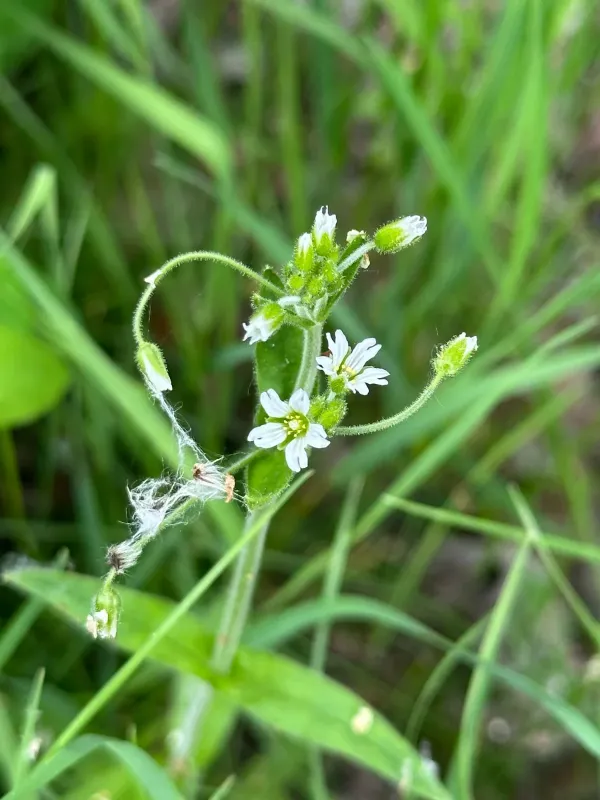
Nodding chickweed (Cerastium nutans) is an annual or biennial herb belonging to the Caryophyllaceae family. It is recognized as a troublesome weed in various agricultural environments.
The plant features stems ranging from 15 to 45 centimeters in height. These stems are often branched, erect or ascending, and are characterized by a glandular-pubescent texture that feels sticky.
Its leaves are arranged oppositely along the stem and have a lanceolate or linear-lanceolate shape. The lower leaves are typically petiolate, while the upper ones are sessile.
The flowers are arranged in loose terminal cymes. They possess white petals that are deeply cleft into two lobes, often equalling or slightly exceeding the length of the sepals.
The seed capsules are distinctively narrow and curved or nodding, which is the primary trait leading to its common name and scientific classification.
Where it grows
Nodding chickweed thrives in moist environments. It is naturally found in river floodplains, wet meadows, along forest edges, and on disturbed soil surfaces.
As a weed, it frequently infests cereal fields, row crops, and vegetable gardens, particularly in areas characterized by high soil moisture levels.
It prefers fertile, loamy, or sandy soils with a neutral to slightly acidic pH, often establishing itself in regions with poor drainage systems.
The native range of the plant is primarily throughout North America, where it has adapted to secondary successions on cultivated farmland.
It quickly colonizes unmaintained edges of agricultural fields, making these areas primary sources of infestation for neighboring cultivated crops.
Harm it causes
The primary damage caused by nodding chickweed is its high competitiveness for water and soil nutrients, especially during the seedling stage of crop development.
By forming dense patches, the weed shades out cultivated crops, significantly reducing their photosynthetic capacity and overall biomass accumulation.
The plant can act as an alternate host for various insects and plant pathogens, which can subsequently migrate to commercial crops and increase phytosanitary risks.
Contamination of harvested grain with the small seeds of nodding chickweed lowers the commercial value and purity of the agricultural product.
Widespread growth of this weed leads to significant depletion of available soil nitrogen and phosphorus, requiring increased fertilizer inputs to offset the losses.
How to control
Agronomic control involves routine deep plowing, which is effective in burying seeds deep enough to prevent germination and destroying existing vegetation.
Crop rotation is a critical component of management, emphasizing the use of competitive cover crops that effectively suppress weed growth through shading and competition.
Inter-row cultivation is highly effective in row crops, as it physically disturbs the root systems and seedlings of the weed before the canopy closes.
Chemical control focuses on the use of selective post-emergence herbicides designed to target broadleaf weeds without damaging the primary crop.
- Regular field scouting to identify and treat early infestations.
- Application of soil-active herbicides before or shortly after planting.
- Maintaining field borders and ditches free of vegetation to limit weed seed dispersal.
Taxonomy
- Latin name
- Cerastium nutans
- Family
- Гвоздичные
- EPPO code
- CERNU