
Broad-leaved mouse-ear
Cerastium latifolium
Description
How to tell it apart
Broad-leaved mouse-ear (Cerastium latifolium) belongs to the Caryophyllaceae family and is recognized as a perennial herbaceous weed in various agricultural regions.
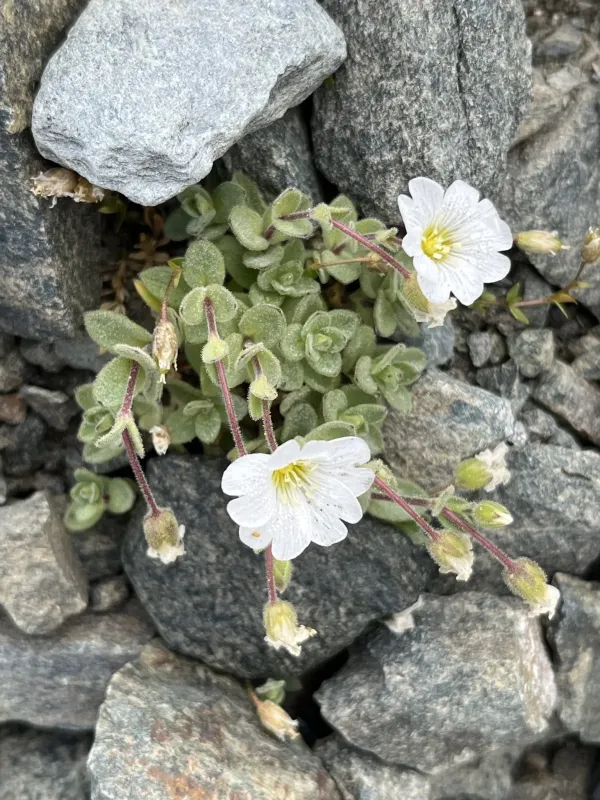
The plant features stems that are often covered in fine glandular hairs, typically growing in a sprawling or ascending habit depending on density.
Its leaves are distinctively broad-ovate or elliptical, providing the primary botanical characteristic that separates it from other Cerastium species.
White flowers, having five notched petals, emerge in loose clusters, making the plant identifiable during its peak flowering phase in the spring.
The root system is capable of significant spreading, allowing the weed to form thick, persistent clumps that dominate the surrounding soil surface.
Where it grows
This weed favors damp, nutrient-rich soils and is frequently found in areas with high moisture availability, such as low-lying field sections.
It thrives in cultivated fields, perennial grass stands, and along the margins of fields where soil disturbance is frequent or persistent.
Cerastium latifolium is highly adaptable to both full sun and partial shade, allowing it to colonize dense crop stands where other weeds might fail.
Spreading is largely facilitated by wind-dispersed seeds and mechanical transport of soil particles via farm machinery during tillage and harvest.
In regions with mild winters, the plant can remain green and active for longer periods, providing a competitive advantage over seasonal crops.
Harm it causes
The primary harm caused by this species is the intense competition for water and nutrients, which restricts the development of primary crops.
By forming dense mats, it effectively shades out crop seedlings, preventing them from achieving adequate light interception for healthy growth.
The presence of this weed increases localized humidity levels, creating an ideal microenvironment for various fungal pathogens to attack crops.
It also acts as an alternative host for several crop pests, complicating integrated pest management strategies and increasing the need for chemical inputs.
In addition to yield suppression, the presence of weed biomass can contaminate harvested grain, lowering its overall grade and market value.
How to control
Effective agricultural control involves deep autumn plowing to uproot and bury rhizomes, significantly reducing the viability of the perennial root network.
Integrating inter-row cultivation within a crop rotation plan is essential for physically removing the weed before it can establish a strong foothold.
Ensuring clean planting material and cleaning equipment between fields are critical steps in preventing the introduction of seeds into new areas.
Chemical control requires the use of systemic herbicides applied during the early growth stages of the weed to maximize translocation to the roots.
Always adhere to local regulations and safety labels when applying herbicides to ensure efficacy and minimize impact on the target crop and environment.
Taxonomy
- Latin name
- Cerastium latifolium
- Family
- Гвоздичные
- EPPO code
- CERLA