
Cerastium julicum
Cerastium julicum
Description
How to tell it apart
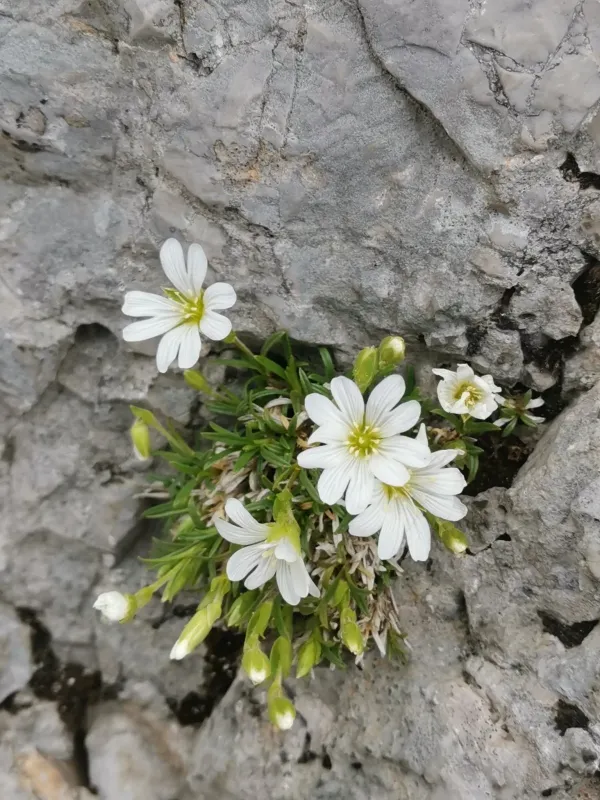
Cerastium julicum is a herbaceous perennial plant belonging to the Caryophyllaceae family. It is characterized by low-growing, branched stems and small opposite leaves that give it a mat-forming appearance in fields.
The flowers are typically white, featuring five deeply cleft petals that are a diagnostic feature of this genus. The entire plant is often covered with fine hairs, which help it withstand dry conditions.
Its root system is fibrous and highly branched, enabling the plant to spread rapidly through vegetative growth. When stems are disturbed or broken, they can easily take root again in moist soil.
Cerastium julicum is notable for its early spring growth, often appearing before many cultivated species have begun their active development. This early start gives it a competitive advantage in securing resources.
The seeds are small and numerous, capable of staying dormant in the soil for several years. Their distribution is facilitated by wind, water runoff, and the movement of agricultural equipment across farmland.
Where it grows
This weed prefers open, sunny environments and is commonly found in winter crop fields, fallow lands, and meadows. It thrives in well-aerated soils but shows remarkable adaptability to various soil types.
Cerastium julicum often colonizes field margins, irrigation ditches, and paths where soil disturbance is frequent. These areas serve as reservoirs for the weed to spread into main crop fields.
In regions with intensive agricultural practices, the weed exploits areas where there is a lack of proper crop rotation. It is particularly persistent in fields where minimal tillage is employed without proper herbicide usage.
The plant's ability to tolerate cold temperatures allows it to persist in northern agricultural zones. It establishes itself effectively in early spring when crop cover is still minimal and ground is exposed.
Irrigated areas provide an ideal habitat for this species, allowing it to form dense carpets that compete with emerging crops for space, light, and soil moisture.
Harm it causes
The primary harm caused by Cerastium julicum is its strong competition with crops for water and mineral nutrients. This competition is most damaging during the early, critical stages of crop growth.
By consuming nitrogen and phosphorus reserves, the weed significantly stunts the growth of adjacent crops, leading to lower biomass and decreased grain yields at the end of the season.
The dense mats formed by this weed create a high-humidity environment at the soil level. This microclimate is conducive to the development of fungal infections and root rot diseases in crop seedlings.
The presence of this weed complicates mechanized harvesting operations. Large patches of Cerastium julicum can clog machinery and increase the amount of foreign matter in the harvested product.
Financial losses occur not only from reduced crop yields but also from the increased costs of post-harvest cleaning and the necessity for supplemental herbicide treatments in subsequent seasons.
How to control
Effective control of Cerastium julicum requires an integrated approach that combines mechanical cultivation with appropriate chemical strategies. Tillage before the weed reaches the flowering stage is essential.
Cultural methods include crop rotation, which forces the weed to adapt to different management cycles. Planting competitive, fast-growing crop varieties can help suppress the spread of Cerastium mats.
Chemical control involves the use of selective systemic herbicides. Applications should be timed when the weed is in its active growing phase to ensure maximum translocation of the herbicide into the root system.
- Regular inter-row cultivation for row crops to disrupt roots.
- Using certified clean seeds to prevent weed introduction.
- Maintaining optimal soil fertility to give crops a competitive advantage.
- Targeted herbicide applications on field borders to stop spread.
Because of the weed's regenerative capacity, it is crucial to avoid leaving fallow land untreated for long periods. Consistent monitoring and timely intervention are keys to long-term population management.
Taxonomy
- Latin name
- Cerastium julicum
- Family
- Гвоздичные
- EPPO code
- CERJU