
Common mouse-ear
Cerastium fontanum
Description
How to tell it apart
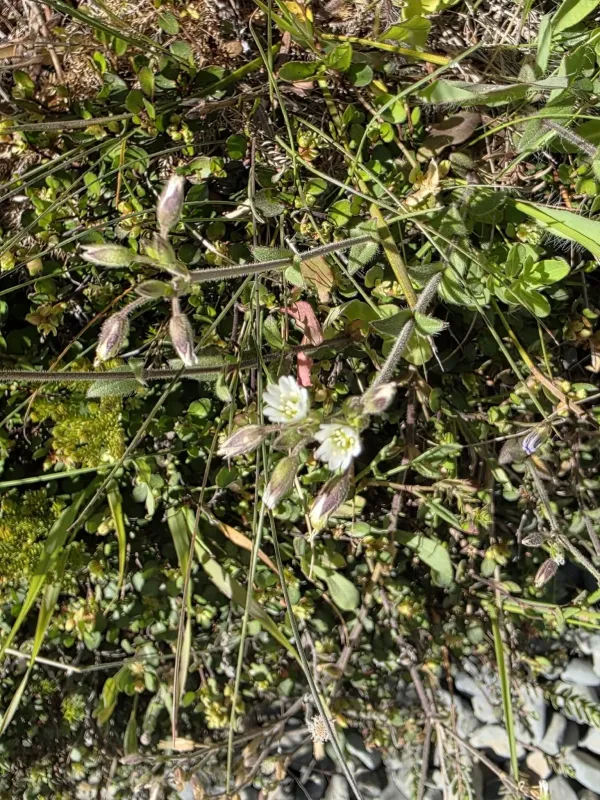
Common mouse-ear (Cerastium fontanum) is a perennial herbaceous plant belonging to the Caryophyllaceae family. It is widely recognized by its low-growing, mat-forming growth habit.
The stems are often trailing or ascending, covered with fine, soft hairs. This pubescence is a key morphological feature that helps distinguish it from other similar species.
The leaves are opposite, ovate-lanceolate, and simple in structure. They provide a dense ground cover, especially in favorable moisture conditions, which allows the plant to dominate early in the season.
Flowers are small with five white, deeply cleft petals. They bloom throughout much of the growing season, producing numerous capsules containing tiny, brown seeds.
The root system is fibrous and quite tenacious. Even small sections of the root or stem can regenerate under proper moisture conditions, contributing to the plant's survival after tillage.
Where it grows
This weed is ubiquitous, commonly found in pastures, meadows, roadsides, and disturbed areas. It thrives in soils ranging from moist to moderately dry.
In agricultural systems, common mouse-ear is a frequent problem in winter cereal crops, grass seed production, and perennial legume fields.
It is particularly problematic in no-till or reduced-tillage systems where it can establish long-term populations without the disturbance of heavy plowing.
The plant demonstrates high ecological adaptability, colonizing both highly fertilized soils and nutrient-poor, compact areas of farmland.
Seeds are easily dispersed by water, machinery, and agricultural tools, which facilitates the rapid spread of the species across large fields.
Harm it causes
Common mouse-ear competes aggressively with crops for water and nutrients, especially in the early spring when the weed begins its active growth cycle.
Its dense matting habit shades the soil surface, hindering the germination and establishment of crop seeds, which can lead to significant thinning of the stand.
The weed acts as a vector for various plant diseases and pathogens that can negatively impact the yield and quality of wheat, barley, and other grain crops.
In livestock production, it reduces the value of pasture by crowding out preferred forage grasses, leading to lower grazing efficiency and decreased animal weight gain.
The regenerative ability of the plant means that traditional mechanical weeding may spread it further if segments of the stem are left in contact with moist soil.
How to control
Management starts with good cultural practices, such as deep plowing to bury the plant parts, which helps to exhaust the weed's energy reserves.
Crop rotation remains one of the most effective strategies to break the weed's lifecycle, particularly by introducing competitive crops that can shade out the mouse-ear.
Chemical control involving selective herbicides is often necessary in cereal crops to remove established populations before they reach the flowering stage.
Timing is crucial: applications must be made during active growth periods for the herbicide to effectively translocate into the root system.
- Use of glyphosate-based herbicides on fallow land for complete weed eradication.
- Implementation of pre-emergent herbicides in specific crop rotations.
- Timely mechanical cultivation to uproot plants before they set seed.
Taxonomy
- Latin name
- Cerastium fontanum
- Family
- Гвоздичные
- EPPO code
- CERFO