
Sea chickweed
Cerastium diffusum
Description
How to tell it apart
Sea chickweed (Cerastium diffusum) is a member of the Caryophyllaceae family. It is an annual herbaceous plant commonly found in agricultural landscapes.
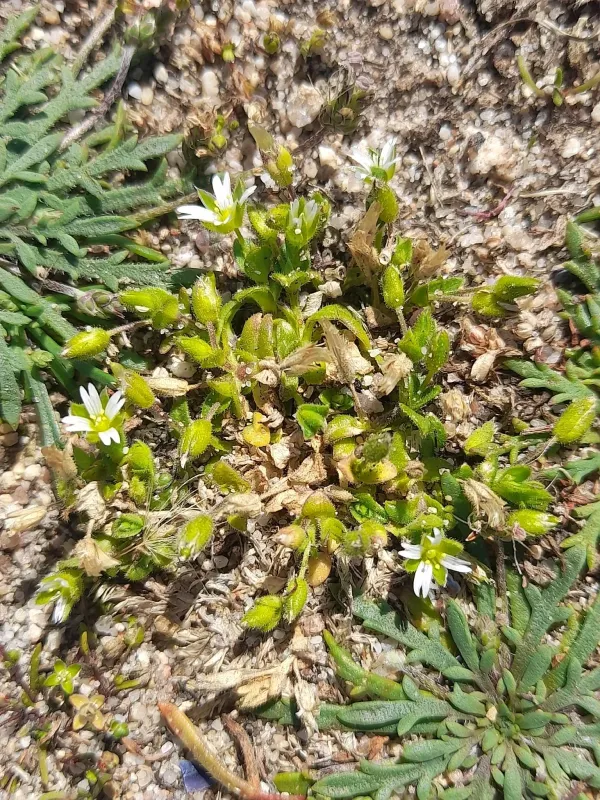
The plant has stems that are branched and often possess glandular hairs, which can make them feel sticky. The plant typically reaches a height of 5 to 20 cm.
Leaves are opposite, with lower leaves being spatulate and upper leaves being lanceolate or ovate in shape. These leaves are relatively small and simple in structure.
The flowers are arranged in loose cymes and feature white petals. A diagnostic feature is that the petals are often shorter than the sepals, setting it apart from similar species.
The fruit is a cylindrical capsule that opens at the tip when mature, releasing a large number of tiny, brownish, and tuberculate seeds into the soil.
Where it grows
This weed prefers light soils such as sandy or loamy-sand textures. It is commonly found in fields, set-aside lands, roadsides, and disturbed environments.
Cerastium diffusum is frequently encountered in winter and spring cereal crops, especially in regions with temperate climates and sufficient moisture.
It exhibits strong ecological plasticity, allowing it to rapidly colonize bare soil and fill niches in thin crop stands or poorly managed agricultural fields.
The weed is known for spreading its seeds efficiently across fields through natural dispersal mechanisms as well as through agricultural machinery during field operations.
It thrives in early spring, often germinating well before many major crop species, which gives it a competitive head start in the growing season.
Harm it causes
The main damage caused by sea chickweed is intense competition with crops for light, nutrients, and soil moisture during the crucial early development stages.
High infestation rates can lead to stunted growth in cereals, reducing the overall vigor and density of the crop stand and ultimately impacting final yield.
By creating a dense cover, the weed can improve the microclimate for certain fungal pathogens and pests that threaten the health of the primary crop.
Large populations of this weed sequester significant amounts of nitrogen and other fertilizers, making them less available to the cultivated plants.
The presence of this weed increases operational costs, as it interferes with uniform crop establishment and may necessitate additional passes with farm machinery.
How to control
Cultural control methods include thorough primary and secondary tillage, which helps eliminate germinating weed seeds before sowing the main crop.
Implementing a balanced crop rotation system helps disrupt the life cycle of the weed and prevents it from becoming dominant in specific fields.
Mechanical harrowing during the seedling stage of the crop is highly effective in removing young sea chickweed plants without damaging the main stand.
Chemical management involves the application of post-emergence herbicides that are labeled for broad-leaved weed control in specific crop types.
Effective chemical application requires timing; treating the weed at the cotyledon or two-leaf stage ensures much higher efficacy than later applications.
Taxonomy
- Latin name
- Cerastium diffusum
- Family
- Гвоздичные
- EPPO code
- CERDF