
Cerastium cerastioides
Cerastium cerastioides
Description
How to tell it apart
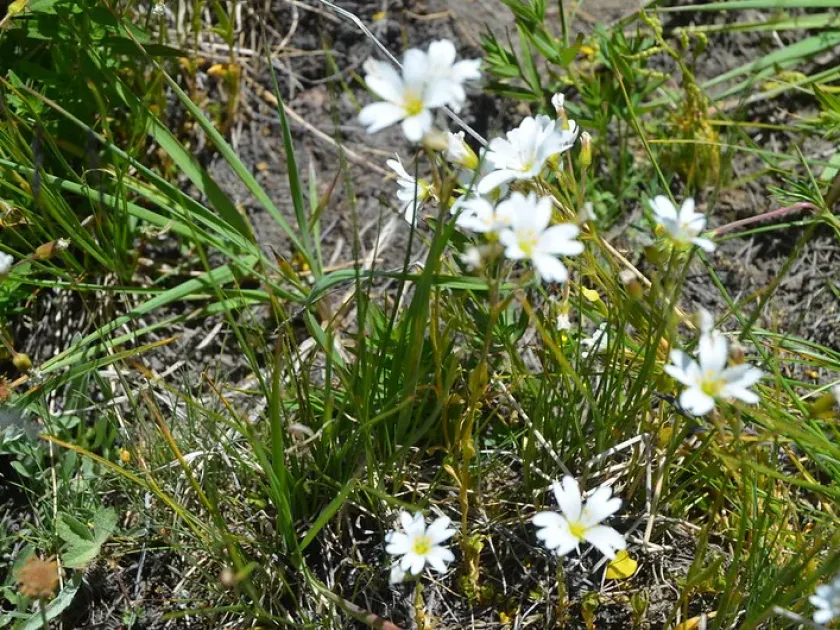
Cerastium cerastioides, commonly known as arctic mouse-ear, belongs to the Caryophyllaceae family. It is a perennial herbaceous plant forming loose tufts or patches.
The stems are prostrate or ascending and often root at the nodes when in contact with moist soil, which aids in rapid vegetative spread across the field.
Leaves are opposite, oblong-lanceolate in shape, and typically glabrous or slightly hairy, serving as a key diagnostic feature for identification.
The flowers are white with deeply notched petals and are distinguished by having three styles, which gives the species its botanical name.
The root system is fibrous and shallow but highly effective at securing the plant in moist, loose substrates, making manual removal from crops difficult.
Where it grows
This weed prefers damp habitats and is frequently found in moist meadows, along streams, and in low-lying areas of agricultural fields where water tends to accumulate.
It thrives in agroecosystems with high soil moisture and compacted soil conditions, often colonizing poorly drained patches within a crop field.
The species is well-adapted to cooler climates and is common in regions with high precipitation, where it can quickly establish dominance in agricultural settings.
Propagation occurs via seeds dispersed by water or wind, as well as through stem fragments moved by agricultural machinery during tillage operations.
It is often seen in perennial forage crops or in fallow fields that have not been managed with proper cultivation techniques to disrupt its spread.
Harm it causes
The primary damage caused by this weed is intense competition with crops for essential soil nutrients and water, particularly during the early growth stages.
By forming dense patches, the plant shades out the seedlings of cultivated plants, significantly hindering their development and overall biomass production.
Its presence maintains a microclimate of high humidity near the soil surface, which promotes the development of fungal diseases and root pathogens in the main crop.
Infestations complicate the mechanical harvesting process, leading to increased crop losses and higher levels of dockage in harvested grain or forage.
In highly infested areas, the presence of the weed reduces the overall quality of the harvest and may necessitate aggressive and costly herbicide applications.
How to control
Effective management begins with improving soil drainage, as the species is highly sensitive to moisture stress and prefers consistently damp conditions.
Standard agronomic practices such as deep fall plowing with complete inversion of the furrow slice are essential to bury and kill vegetative fragments of the weed.
Implementing a diverse crop rotation that includes row crops allows for mechanical inter-row cultivation, which is highly effective in suppressing the weed.
- Mechanical cultivation of inter-rows to uproot and desiccate the weeds.
- Use of selective systemic herbicides during the plant's active growth phase.
- Cleaning agricultural equipment between fields to prevent the spread of seeds and fragments.
Chemical control involving selective post-emergence herbicides should be applied according to local regulations to target the weed while minimizing crop phytotoxicity.
Taxonomy
- Latin name
- Cerastium cerastioides
- Family
- Гвоздичные
- EPPO code
- CERCE