
Short-stalk mouse-ear
Cerastium brachypodum
Description
How to tell it apart
Cerastium brachypodum, commonly known as the short-stalk mouse-ear, belongs to the Caryophyllaceae family. It is an annual herbaceous plant often found in agricultural settings and disturbed sites.
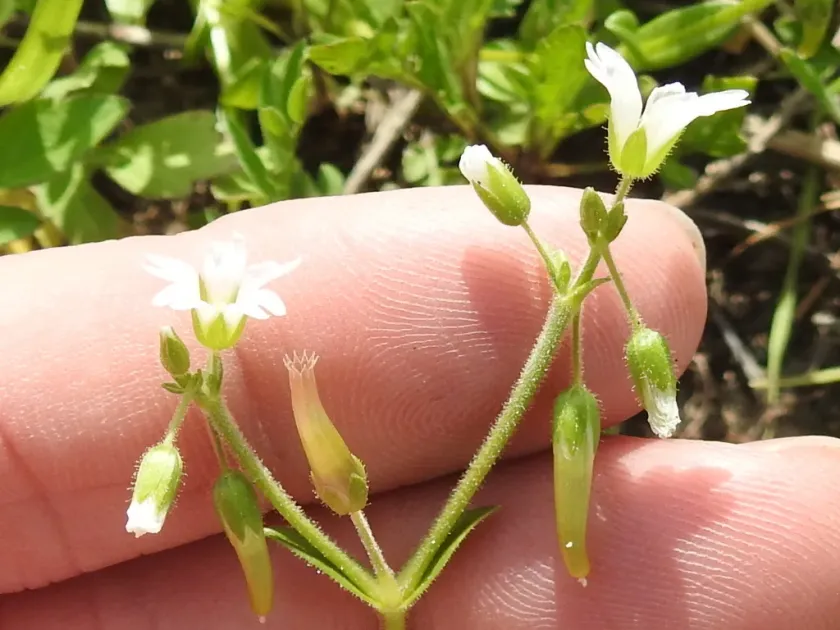
The plant features glandular-pubescent stems, reaching heights of 5 to 20 cm. Its leaves are opposite, typically oblong, and covered in fine, greyish hairs which give it a dusty appearance.
Small white flowers bloom at the stem tips, characterized by deeply notched petals. The fruit is a cylindrical capsule that opens with small teeth when the seeds are mature.
The root system is primarily taproot-based but relatively shallow, allowing the plant to rapidly extract moisture from the upper soil horizons during early spring.
Seeds are tiny, dark-colored, and tuberculate, which aids in their dispersal via wind, water, and agricultural equipment.
Where it grows
This weed thrives in open, sunny environments with light, sandy, or loamy soils. It is frequently observed in winter cereal fields and spring-sown crops.
Cerastium brachypodum also colonizes field edges, road verges, and fallow land, acting as a reservoir for infestation on productive farmland.
It displays strong resilience to early spring frosts, which allows it to emerge ahead of many crop plants and establish itself firmly in the field environment.
The plant is highly adaptable, though it shows a preference for well-drained, nutrient-rich soils where it can compete effectively with young crop seedlings.
Given its fast growth cycle, it is a dominant competitor during the early vegetative stages of small grain crops in various climatic conditions.
Harm it causes
The primary damage is caused by competition for essential nutrients and water, which is particularly detrimental during the initial growth stages of agricultural crops.
Dense patches of this weed can lead to canopy shading, significantly suppressing the growth and tillering potential of cereal plants, ultimately reducing yields.
It can serve as an alternative host for various pests and diseases that jeopardize the health of neighboring crops, complicating plant protection efforts.
Harvesting efficiency is often reduced when weed pressure is high, as the biomass of the weed clogs machinery and increases moisture in the final grain product.
The massive seed production of the species leads to long-term soil seed bank contamination, ensuring continued emergence in subsequent seasons.
How to control
Integrated weed management is essential, beginning with diverse crop rotations to disrupt the reproductive cycle of the weed in the fields.
Mechanical operations like autumn plowing are crucial to bury seeds at depths that prevent successful germination in the spring.
Early-season mechanical weeding, such as harrowing in grain crops, can physically remove young rosettes and significantly decrease the population density.
Chemical control involves the application of selective herbicides during the rosette or early flowering stage to prevent seed formation and shedding.
- Utilizing clean, certified seeds to prevent the introduction of new weed populations.
- Managing soil moisture and nutrient placement to favor crop competitive advantage.
- Applying systemic herbicides in accordance with registered labels for specific crops.
Taxonomy
- Latin name
- Cerastium brachypodum
- Family
- Гвоздичные
- EPPO code
- CERBP