
Arctic mouse-ear
Cerastium arcticum
Description
How to tell it apart
Arctic mouse-ear (Cerastium arcticum) belongs to the Caryophyllaceae family. This perennial herbaceous plant forms low, dense mats, often creeping along the soil surface.
The stems are typically pubescent, a defensive adaptation to harsh growing conditions. The leaves are opposite, oblong-lanceolate or ovate in shape, and often have a glaucous tint due to glandular hair covering.
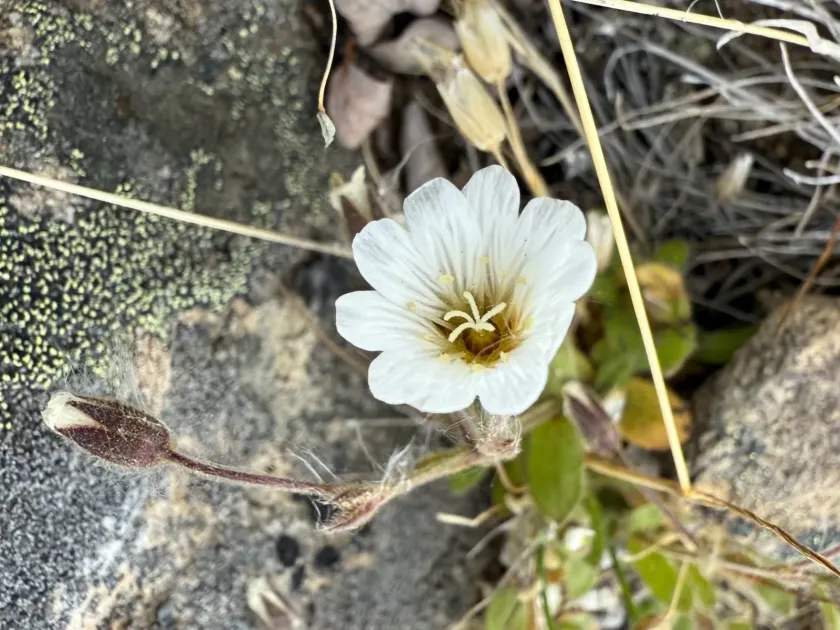
The flowers have the characteristic five-petaled white corolla of the Caryophyllaceae family. The petals are often deeply notched at the tip, giving them a bilobed appearance. The fruit is a multi-seeded capsule opening with teeth.
The root system consists of branched rhizomes capable of vegetative reproduction. It is the presence of these rhizomes that makes this species a potentially dangerous weed, as mechanical disturbance aids in its spread.
Reproduction occurs through both generative means (seeds) and vegetative spread (rhizome segments). The seeds exhibit high germination rates and can persist in the soil for several seasons until favorable conditions arise.
Where it grows
Arctic mouse-ear primarily inhabits regions with severe climates, preferring open areas, rocky slopes, and sites with sparse vegetation cover.
In an agricultural context, this weed is found mainly in northern regions or on sites with excessive moisture and poor soil, where competition from crops is reduced.
Arctic mouse-ear frequently infests perennial grasses and winter crop fields. It is capable of surviving in low-temperature conditions, making it a difficult weed to eradicate in specific agro-climatic zones.
The plant successfully adapts to various soil types, including gravelly and sandy substrates. In fields with disturbed agronomic backgrounds, it quickly occupies empty niches, hindering the development of the main crop.
Due to its biological resilience, this weed is often found on field margins and uncultivated edges, from where seeds spread to agricultural land via wind or farm machinery.
Harm it causes
The primary harm lies in direct competition with crops for mineral nutrients and moisture during the early spring period, as Arctic mouse-ear begins vegetation earlier than many others.
Field infestation leads to significant yield losses by suppressing the growth of young crop shoots. The dense mats of this weed create shading, which is critical for light-demanding agricultural crops.
The presence of this weed complicates field operations, as rhizomatous forms require specific soil tillage. Constant presence of the weed leads to the depletion of the topsoil layer.
Arctic mouse-ear can serve as a reservoir for various phytopathogens and pests that can later transition to crops. This increases the risk of plant diseases and requires additional costs for fungicides.
The high intensity of vegetative reproduction promotes rapid expansion over large areas, which complicates control efforts and makes managing the weed an economically costly task.
How to control
Agricultural control measures include deep autumn plowing with moldboard turnover, which buries rhizomes at depths that prevent germination. Regular inter-row cultivation is also effective.
An important practice is the use of crop rotation, including crops capable of suppressing weeds through rapid canopy development. Using high-quality, cleaned seed material prevents the introduction of seeds onto the field.
Chemical control is based on the use of systemic broad-spectrum herbicides during the active growth phase before flowering. Glyphosate-based preparations are most effective on fallow fields.
In winter cereal crops, selective herbicides targeting dicotyledonous weeds can be used. The choice of herbicide depends on the weed spectrum and the developmental stage of the crop.
- Regular field monitoring during the early spring.
- Mechanical removal of expansion hotspots on field boundaries.
- Timely fertilization of crops to provide a competitive advantage.
Taxonomy
- Latin name
- Cerastium arcticum
- Family
- Гвоздичные
- EPPO code
- CERNA