
Alpine mouse-ear
Cerastium alpinum
Description
How to tell it apart
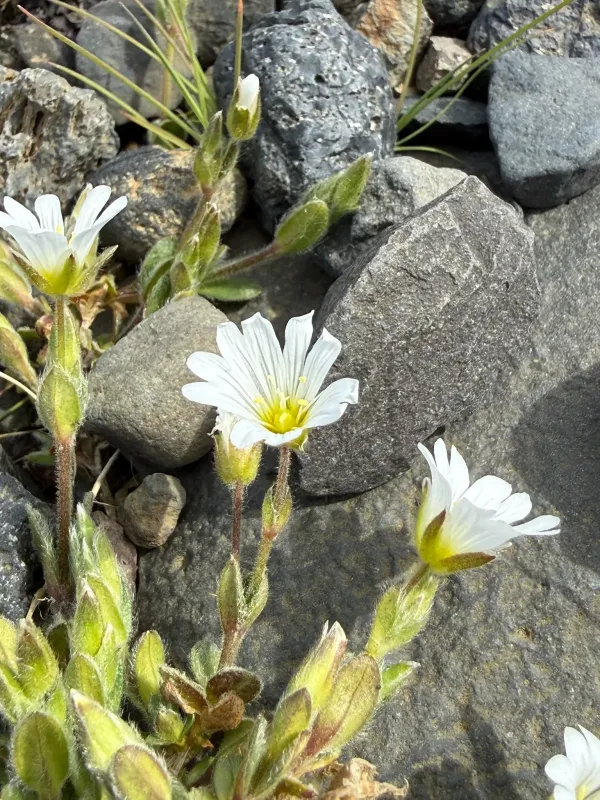
Alpine mouse-ear (Cerastium alpinum) belongs to the Caryophyllaceae family. It is a perennial herbaceous plant with stems that are often decumbent or ascending, forming loose mats or tufts.
The leaves are opposite, oblong-ovate, and covered with dense, woolly-white pubescence, which gives the plant a grayish-green appearance. The stems share this characteristic hairy texture.
Flowers are arranged in small clusters at the tips of the stems. The petals are white, deeply notched (bifid), and typically twice as long as the sepals, making them easily recognizable during the flowering phase.
The root system is composed of creeping rhizomes that allow the plant to spread vegetatively, enabling it to colonize rocky or sandy surfaces effectively.
The fruit is a cylindrical capsule that splits into ten teeth at the apex when mature, releasing a large number of tiny, dark brown seeds into the surrounding environment.
Where it grows
This species thrives in open, high-light environments. In its natural habitat, it is commonly found on stony slopes, in alpine meadows, on gravel beds, and in areas with rocky soil debris.
In agricultural settings, Alpine mouse-ear is most frequently encountered in fields with light, sandy, or loamy soils, particularly in regions with cooler, temperate climates.
It readily colonizes fallow fields, road verges, and uncultivated edges, from which it can penetrate into established crops, especially perennial grasses and cereals.
The plant demonstrates high ecological plasticity and is highly tolerant of cold temperatures, making it a persistent weed in northern latitudes or high-altitude agricultural zones.
It prefers areas that maintain high moisture levels during the spring, which often allows it to establish dominance before the main crops have fully emerged.
Harm it causes
The primary damage caused by Alpine mouse-ear is its competitive nature, as it competes for space, nutrients, and soil moisture, which significantly impacts the development of young crops.
Due to its dense, mat-forming growth habit, the weed can inhibit the tillering process and early development of cereal crops, leading to reduced stand density.
The seeds can remain viable in the soil for several years, creating a permanent seed bank that makes complete eradication difficult and requiring long-term field management.
In fields grown for hay or pasture, the presence of Alpine mouse-ear degrades the quality of the forage because its hairy, fibrous stems are less palatable to livestock.
Its ability to propagate via rhizomes makes mechanical weeding difficult, as even small fragments left in the soil can lead to the regrowth of the weed population.
How to control
Effective management begins with rigorous primary tillage. Deep plowing, which turns the soil layers, is essential to bury rhizomes and prevent them from re-establishing.
Strategic crop rotation is a vital component of control. Including crops that require intensive inter-row cultivation helps to suppress the weed population over multiple seasons.
In cereal crops, the use of selective post-emergence herbicides, such as sulfonylureas or auxin-mimic compounds, can be highly effective in controlling this broad-leaved weed.
- Shallow cultivation in the autumn to encourage weed seed germination for subsequent destruction.
- Ensuring the use of certified, clean seed to prevent introduction of the weed into new areas.
- Application of systemic herbicides during the active growth stage of the weed.
It is crucial to prevent the plant from reaching the flowering and seed-setting stage, as this prevents the replenishment of the soil seed bank and reduces future infestation risk.
Taxonomy
- Latin name
- Cerastium alpinum
- Family
- Гвоздичные
- EPPO code
- CERAL