
Saltwort
Batis maritima
Description
How to tell it apart
Saltwort (Batis maritima) belongs to the Bataceae family. It is a perennial succulent plant that grows as a low, spreading shrub, forming dense, fleshy mats across the soil surface.
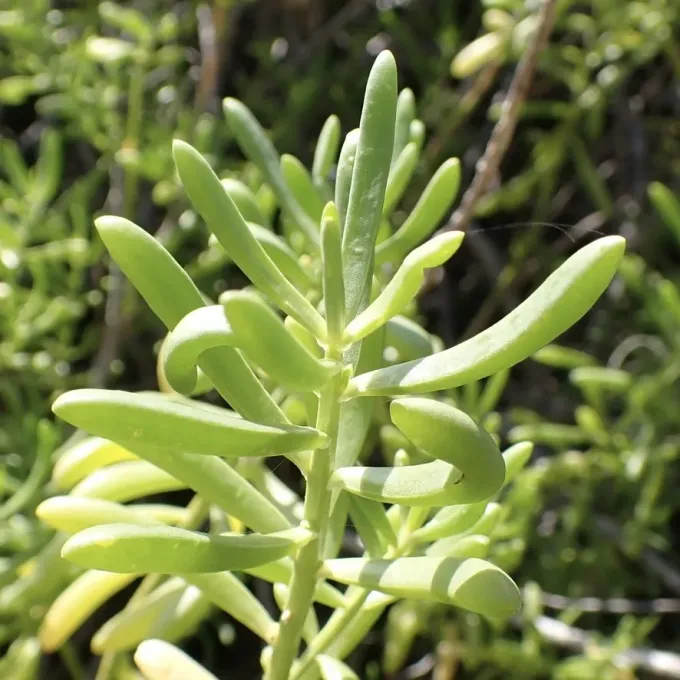
The stems are branched and can reach heights of 30-50 cm. Its leaves are opposite, succulent, and cylindrical or spindle-shaped, typically displaying a bright green color with yellowish tints.
Flowers are small, dioecious, and arranged in dense spike-like inflorescences. Male flowers feature noticeable scales, while female flowers are hidden within bracts, making them difficult to identify in the field.
The plant has a robust, extensive root system that allows it to anchor firmly in shifting substrates and effectively extract moisture from saline environments.
Fruits are fleshy, multi-seeded drupes that fuse into collective clusters. This structure ensures high reproductive success and survival in harsh coastal conditions.
Where it grows
Saltwort is widely distributed across tropical and subtropical regions of the Americas. It is a characteristic inhabitant of coastal marshes, mangrove margins, and saline coastal stretches.
The plant thrives in sandy or muddy substrates with high salt content. It is frequently found in areas subject to periodic tidal inundation, which suppresses competitors that are not salt-tolerant.
In agriculture, Batis maritima becomes a significant nuisance when developing saline soils for irrigation. It colonizes drainage canals, irrigation ditches, and areas with high water tables.
The weed rapidly invades open areas, outcompeting crops that lack physiological adaptations for high salinity levels.
Its high adaptability makes it a dominant species in specific agro-climatic zones where soil mineral composition prevents the growth of standard crop varieties.
Harm it causes
The primary impact of saltwort is a significant reduction in crop yields. As an aggressive halophyte, it competes intensely for space and soil nutrients, stifling the development of nearby crops.
In irrigated farming, saltwort clogs water channels, significantly reducing the efficiency of hydraulic systems. This leads to sedimentation and high costs for frequent mechanical maintenance.
The plant serves as a reservoir for various pests and pathogens, which can subsequently migrate to adjacent agricultural fields, worsening the phytosanitary conditions of the farm.
Dense thickets of saltwort impede mechanized field operations. These patches obstruct heavy machinery and degrade the quality of primary soil tillage.
Due to its biological resilience against environmental stressors, saltwort remains a difficult-to-eradicate weed in regions with high soil salinity.
How to control
Effective control of saltwort relies heavily on agro-technical reclamation. Leaching the soil to reduce excess salt concentrations creates a less favorable environment for this halophyte.
Mechanical removal through deep plowing and disking suppresses current populations, though it requires consistency due to the plant’s ability to propagate vegetatively.
Chemical control involving non-selective herbicides is recommended for non-crop areas, such as canal banks and irrigation infrastructure, to limit the spread of the weed.
Integrating salt-tolerant crop varieties into the rotation cycle helps suppress saltwort. Denser crop canopies provide shade, limiting the light available for the weed's photosynthesis.
- Leaching irrigation regimes.
- Systematic maintenance of drainage networks.
- Strategic crop rotation.
- Targeted herbicide application in non-crop zones.
Taxonomy
- Latin name
- Batis maritima
- Family
- Батовые
- EPPO code
- BAGMA