
Tristellateia australasiae
Tristellateia australasiae
Description
How to tell it apart
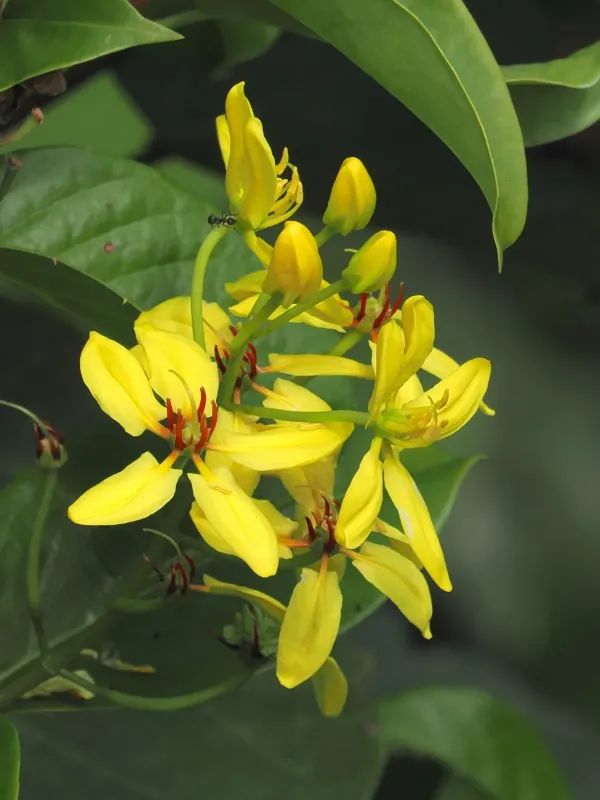
Tristellateia australasiae is a perennial woody vine belonging to the Malpighiaceae family. It is characterized by opposite, ovate leaves and bright yellow flowers that feature ten distinct stamens, making it easily recognizable in the field.
The plant produces unique star-shaped fruits that develop into winged seeds (samaras). These wings allow the seeds to be dispersed over long distances by wind, facilitating the rapid colonization of new areas.
The root system is robust and penetrates deep into the soil, providing the plant with excellent resilience and survival capabilities under various environmental stressors. Its stems can grow several meters long, aggressively climbing and entangling nearby vegetation.
Flowering occurs almost year-round in tropical climates, which complicates the timing of weed management efforts. The seeds exhibit high germination rates, even in nutrient-poor soils, which contributes to its success as an invasive species.
The plant is highly adaptable to diverse soil types, ranging from sandy coastal areas to heavier agricultural soils. This ecological plasticity makes it a difficult competitor for native species and agricultural crops.
Where it grows
The natural habitat of Tristellateia australasiae includes coastal zones of tropical Asia, Australia, and the Pacific Islands. It is commonly found in forest fringes, mangroves, and coastal thickets where moisture is abundant.
In agricultural settings, it frequently invades perennial plantations such as orchards and palm groves. It typically starts by colonizing field margins before spreading into the interior of the cultivated area.
Disturbed ecosystems and abandoned farmland serve as primary reservoirs for this species. From these locations, the plant easily migrates into productive fields, utilizing water runoff and equipment movement for dispersal.
The vine thrives in areas with minimal competition, where it can quickly establish dense monocultures. Once established, it can alter the local environment by shading out ground-level vegetation and changing soil moisture dynamics.
The spread of this weed is often exacerbated by human activity, particularly the movement of farm machinery that carries stem fragments to new, uncontaminated plots.
Harm it causes
The primary damage caused by this vine is the physical smothering of crops. By tightly wrapping around trunks and branches, it deforms plants and severely restricts their growth and sunlight access.
Tristellateia australasiae competes directly with crops for water and essential nutrients, which results in significant yield reduction and increased susceptibility to other environmental stressors.
The dense thickets formed by the vine create a microclimate with high humidity and poor ventilation. This environment is ideal for the proliferation of fungal pathogens and various insect pests that attack the main crops.
Mechanical removal is challenging because even small segments of roots or stems left in the soil can regenerate, making it difficult to completely eradicate the plant from a field.
The presence of the weed increases production costs by complicating harvest operations. Workers face physical barriers when accessing crops, and machinery can become entangled in the dense vines, leading to equipment damage.
How to control
Effective control involves regular pruning or slashing of the vines before they reach the flowering and seed-production stage. Complete removal, including the root system, is essential to prevent rapid regrowth.
Mulching is a highly effective preventative measure. Covering the soil around young trees with thick organic or synthetic mulches creates a physical barrier that prevents seeds from reaching the soil surface.
Chemical control should be implemented using systemic herbicides. Applying concentrated solutions to freshly cut stumps is a highly efficient method that minimizes chemical drift and protects non-target crops.
Implementing an integrated pest management (IPM) strategy that combines manual removal with selective chemical treatment is the most sustainable approach for large-scale agricultural infestations.
- Manual weeding of young plants.
- Systemic herbicide application.
- Regular field boundary inspections.
- Mulching around crops.
- Cleaning machinery to prevent seed transfer.
Taxonomy
- Latin name
- Tristellateia australasiae
- Family
- Мальпигиевые
- EPPO code
- TSLAU