
Common smilax
Smilax aspera
Description
How to tell it apart
Common smilax (Smilax aspera) is a perennial evergreen woody vine belonging to the Smilacaceae family. It is easily identified by its flexible stems densely armed with sharp, curved prickles that allow it to climb over trees, shrubs, and fences.
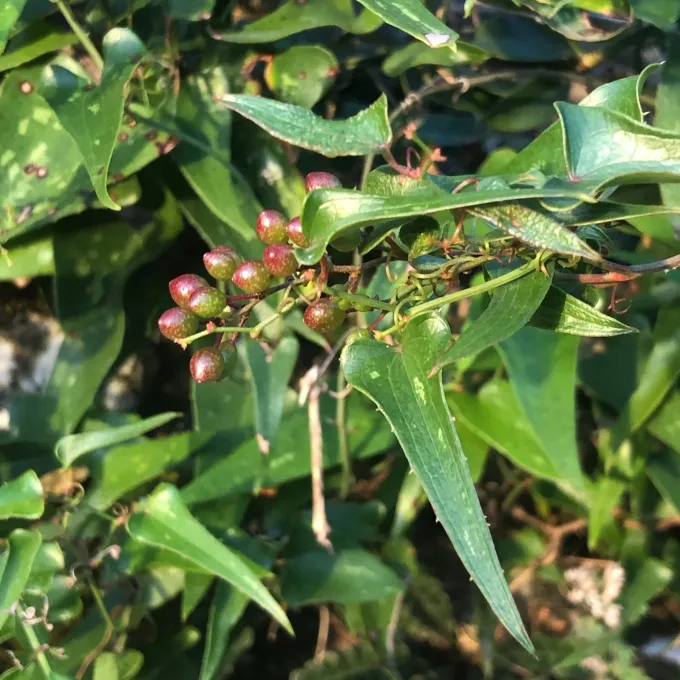
The leaves are typically heart-shaped or arrowhead-shaped with a leathery texture. They can be entire or toothed, often exhibiting whitish mottling on the surface. The plant possesses a robust, woody underground rhizome system that stores significant reserves of nutrients.
During the flowering season, the plant produces small, greenish-white to yellowish flowers arranged in axillary umbels. These are followed by spherical berries that turn from bright red to nearly black upon reaching maturity.
As a perennial rhizomatous weed, common smilax exhibits high regenerative capacity. It is capable of resprouting from even small sections of the rhizome that remain in the soil after mechanical or manual clearing attempts.
The species displays a high level of ecological plasticity, which allows it to thrive in diverse conditions. Its ability to grow both in sun and partial shade contributes to its success as an invasive colonizer in disturbed areas.
Where it grows
Common smilax is native to Mediterranean-type climates, where it frequently inhabits shrublands, forest edges, and rocky hillsides. It often thrives near hedgerows and along the perimeters of cultivated agricultural land.
In agricultural settings, it is a significant nuisance in orchards, vineyards, and olive groves. It competes aggressively with crops for light, space, and soil nutrients, often suffocating younger trees or vines under its heavy foliage.
The weed favors a wide range of soil types, from sandy to clay-rich soils. Once established in unmanaged areas or fallow lands, it rapidly spreads into adjacent cultivated fields, causing severe damage to production.
Its natural distribution is focused primarily on Southern Europe and the Caucasus region, where the warm climate supports year-round growth and vigorous expansion of its complex vine network.
Because it forms dense, entangled masses, it can occupy large areas, effectively turning sections of agricultural land into impenetrable thickets that are difficult to access for routine maintenance or harvesting.
Harm it causes
The primary damage caused by common smilax is the physical strangulation of crop plants. By wrapping its prickly stems around the trunks and branches of trees, it causes deformation and inhibits the development of the canopy.
The presence of sharp thorns makes field management hazardous and labor-intensive. Pruning, thinning, and harvesting become dangerous and slow, as farm workers must exercise extreme caution to avoid injuries.
Common smilax acts as a heavy competitor for essential soil moisture and mineral resources. Its extensive root network can significantly deplete soil water levels, leading to moisture stress for crops during dry seasons.
The plant acts as a reservoir for various pests and fungal diseases. The dense tangle of vines prevents proper ventilation and light penetration, creating a microclimate that favors the spread of pathogens throughout the orchard or field.
If left unmanaged, the weed creates significant economic losses by reducing total crop yields and increasing the operational costs associated with manual weed removal and mechanical site preparation.
How to control
Mechanical control involves the repeated cutting of the above-ground stems. While this prevents seed production and reduces the plant's vigor, it is not a long-term solution unless paired with the removal of the underground rhizomes.
Chemical control utilizing systemic herbicides is often the most effective approach for large infestations. Herbicides are best applied during the active growth phase, as this ensures the active ingredient is translocated down to the rhizome.
Sanitation is key to preventing re-infestation; fruits should be removed before they mature to prevent birds from dispersing seeds into new areas. Establishing clear buffer zones around fields can help contain the spread.
A multi-modal approach combining chemical treatment to weaken the root system followed by deep mechanical tillage to extract the rhizomes is highly recommended for complete eradication in agricultural plots.
- Regular manual cutting of stems.
- Deep tillage for rhizome extraction.
- Systemic herbicide application during active growth.
- Strategic removal of berries to prevent seed spread.
Taxonomy
- Latin name
- Smilax aspera
- Family
- Смилаксовые
- EPPO code
- SMIAS