
Giant salvinia
Salvinia molesta
Description
How to tell it apart
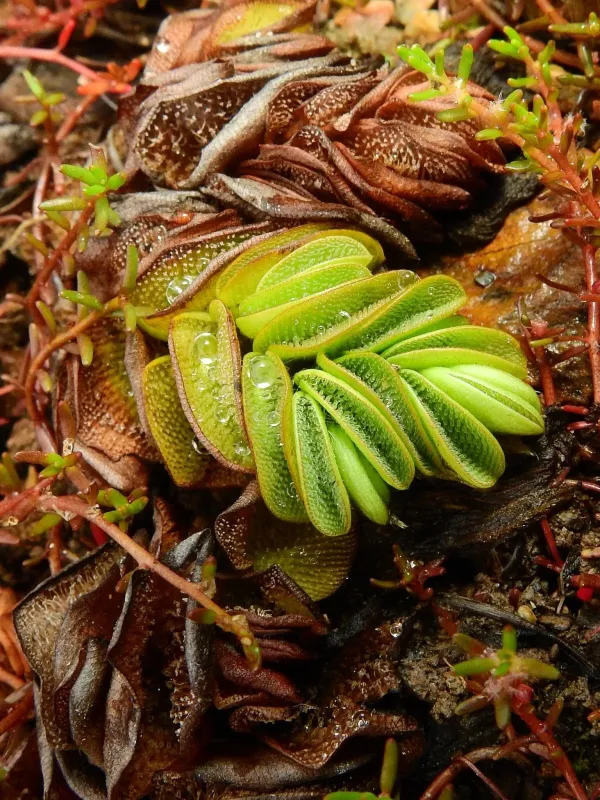
Giant salvinia (Salvinia molesta) is a free-floating aquatic fern belonging to the Salviniaceae family, characterized by the lack of true roots and a highly rapid growth rate.
The plant features horizontal stems that bear leaves in whorls; the leaves are covered with unique, egg-beater shaped hairs that trap air, providing a silvery appearance.
Under favorable conditions, the plant forms thick, multi-layered mats on the water surface, which can reach depths of up to several inches or even more.
Reproduction is exclusively vegetative, meaning that even a small fragment of the plant can regenerate into a new colony, making its removal extremely challenging.
It can be distinguished from other Salvinia species by the specific structure of its leaf hairs and its tendency to rapidly change leaf shape as the plant matures and becomes crowded.
Where it grows
This invasive weed thrives in slow-moving or stationary freshwater environments, including lakes, ponds, irrigation canals, and flooded agricultural fields like rice paddies.
It prefers tropical and subtropical climates where stable warm temperatures allow for exponential growth throughout the entire year without a dormant period.
Giant salvinia is often introduced to new areas via the ornamental plant trade, eventually escaping into natural waterways where it faces no natural competition.
The plant exhibits high tolerance to a wide range of water conditions, allowing it to easily colonize degraded, nutrient-rich environments often found near farmland.
Once established in irrigation systems, it moves easily with water flow, causing significant logistical hurdles for agricultural water supply management.
Harm it causes
The primary ecological harm is the creation of dense surface mats that block sunlight, preventing photosynthesis and leading to the decline of native aquatic flora.
As the plant dies and decays, it consumes massive amounts of dissolved oxygen, which often results in fish kills and the degradation of the overall water quality.
In agricultural settings, Giant salvinia disrupts rice production by competing for space and nutrients while hindering the efficient use of irrigation machinery.
The plant poses a direct threat to water infrastructure, clogging pumps, intakes, and drainage pipes, which leads to increased maintenance costs and operational failures.
By restricting water movement, it can exacerbate flooding issues in agricultural areas, as channels become clogged and unable to carry the required volume of water.
How to control
Mechanical control involves the use of specialized harvesting equipment to physically remove mats from the water surface, though it requires repeated intervention.
Biological control, specifically the use of the weevil Cyrtobagous salviniae, has proven highly successful in reducing population densities in many infested countries.
Chemical control is an option using aquatic-approved herbicides, but it must be performed with caution to ensure the safety of the surrounding ecosystem and wildlife.
Integrated pest management strategies often combine mechanical clearing of major infestations with the introduction of biological agents for long-term population suppression.
- Implementing strict containment protocols to prevent accidental transport of fragments.
- Regular monitoring of water bodies to detect early outbreaks of the weed.
- Collaborating with local farmers to manage nutrient runoff into irrigation canals.
Taxonomy
- Latin name
- Salvinia molesta
- Family
- Сальвиниевые
- EPPO code
- SAVMO