
Dyer's mignonette
Reseda luteola
Description
How to tell it apart
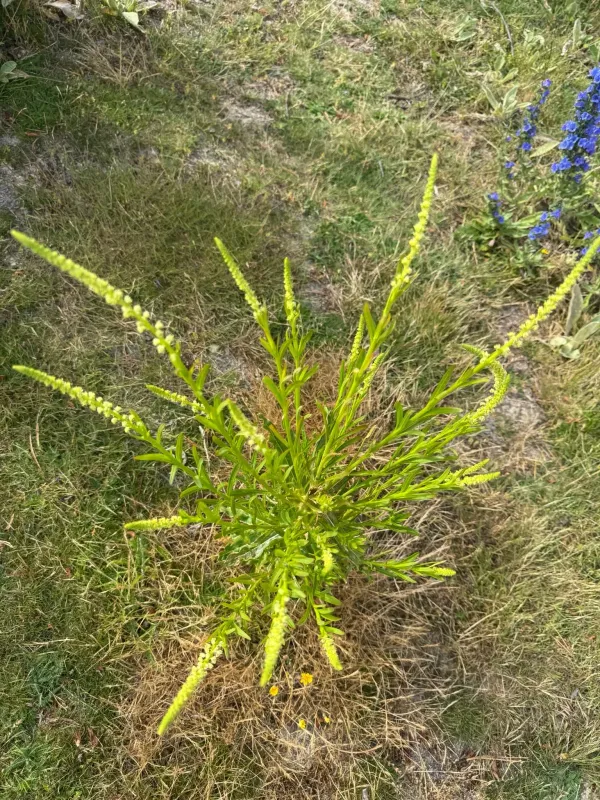
Dyer's mignonette (Reseda luteola) is a biennial or annual herbaceous plant belonging to the Resedaceae family. In its first year, it forms a basal rosette of leaves, while in the second year, it produces a tall, leafy stem that can reach 1.5 meters.
The leaves are narrow, lanceolate, and entire with wavy margins. They are arranged spirally around the stem, giving the plant a distinctive appearance during the growth stage.
The inflorescences are dense, terminal racemes of small, yellowish-green flowers. These appear from early summer through late summer, facilitating extensive seed production.
The fruit is a dry capsule containing numerous tiny, dark-colored seeds. A single plant can produce tens of thousands of seeds, which are easily dispersed by wind, water, and farm equipment.
It possesses a strong, deep taproot that allows the plant to thrive in nutrient-poor soils and resist drought by accessing water from deep underground layers.
Where it grows
Dyer's mignonette prefers sunny, open environments with dry, calcareous, or alkaline soils. It is frequently found on waste grounds, roadsides, and disturbed fields.
In agricultural settings, it is a significant weed in cereals, meadows, and pastures. It often exploits areas where the crop stand is thin or poorly established.
It acts as a pioneer species on abandoned land and quickly establishes itself in agricultural systems where soil management practices are insufficient.
Due to its high adaptability, it can be found in various climatic regions, spreading rapidly if left uncontrolled on field borders or non-cropped areas.
Contaminated farm equipment is one of the primary vectors for the introduction of Reseda luteola seeds into previously clean fields.
Harm it causes
The primary damage caused by Dyer's mignonette is intense competition with crops for water, sunlight, and soil nutrients. Its deep root system makes it particularly efficient at extracting resources.
When present in large numbers, it shades young crops, suppressing their growth and reducing the overall density of the crop stand, which directly impacts yield potential.
Harvesting efficiency is significantly reduced due to the robust, woody stems of the mature plants, which can clog or damage combine harvester mechanisms.
The presence of its seeds in harvested grain is difficult to manage, often requiring specialized cleaning equipment to ensure the quality and purity of the commodity.
It can host pests and diseases, serving as a reservoir that allows harmful organisms to survive and migrate onto economically important crops throughout the growing season.
How to control
Effective control starts with a robust crop rotation strategy that includes competitive crops capable of shading out weed seedlings during their initial development.
Mechanical control through deep tillage is essential to destroy the root system of first-year rosettes before they transition into the rapid growth stage of the second year.
Chemical intervention with selective herbicides is highly effective when applied during the early growth stages of the weed, typically while it is still in the rosette phase.
Field maintenance, including the mowing of roadsides and fence lines, prevents the spread of seeds into the main production areas of the farm.
- Use high-quality, certified, and weed-free seed for sowing.
- Implement timely cultivation in row crops to suppress weed emergence.
- Apply herbicides according to the specific growth stage of the weed and the host crop.
Taxonomy
- Latin name
- Reseda luteola
- Family
- Резедовые
- EPPO code
- RESLT