
Pikea californica
Pikea californica
Description
How to tell it apart
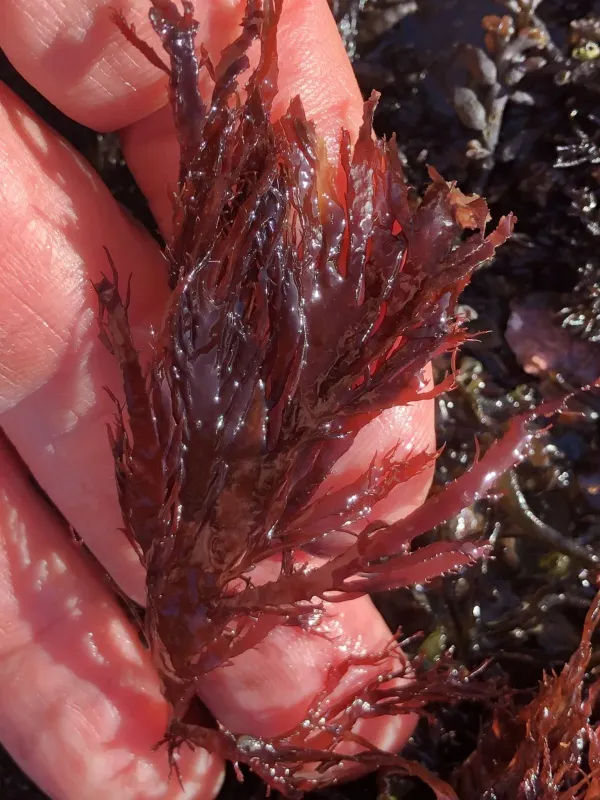
Pikea californica is a species of red algae belonging to the Dumontiaceae family. It is characterized by a bushy thallus structure with narrow, compressed branches.
The plant typically exhibits a dark red to brownish-red color and attaches to rocky substrates via a firm discoid holdfast.
Botanically, it is a perennial organism that thrives in intertidal zones, displaying a complex lifecycle that involves both sexual and vegetative stages.
For agricultural professionals working in mariculture, identifying this species correctly is essential to distinguish it from desired crop species.
The flexible and branched nature of the thallus allows it to withstand significant wave action while simultaneously expanding its surface area to maximize nutrient absorption.
Where it grows
The natural habitat of this species is along the Pacific coast, specifically in areas with rocky intertidal and shallow subtidal zones.
In the context of aquaculture, it becomes an agricultural concern when it invades managed coastal ponds or tanks used for seaweed or shellfish cultivation.
It prefers high-energy environments with consistent water flow, allowing it to acquire nutrients rapidly and colonize available empty spaces on submerged structures.
Pikea californica can colonize both natural rock surfaces and artificial farming equipment, including ropes, nets, and drainage pipes.
Its ability to adapt to varying salinity levels makes it a resilient inhabitant of coastal water systems, complicating its elimination once established.
Harm it causes
The primary harm is the mechanical fouling of water intake systems and filtration equipment, which increases maintenance costs and labor time.
By competing for essential nutrients such as nitrogen and phosphorus, it significantly reduces the growth rates and yield of the primary aquaculture crop.
The decomposition of large biomass accumulations can lead to localized hypoxic conditions, which negatively affect the health of farmed species.
Its rapid growth can obstruct water circulation, preventing uniform nutrient distribution throughout the farming site.
Furthermore, it creates an unfavorable habitat for commercial species, acting as an invasive competitor that alters the local biodiversity of the aquaculture system.
How to control
Mechanical removal remains the most effective strategy, involving the periodic cleaning of nets, ropes, and submerged surfaces to keep populations low.
Adjusting the environmental conditions within farming ponds, such as altering water flow velocity, can create unfavorable conditions for algal colonization.
Chemical control is generally avoided because the potential for toxicity towards beneficial organisms and the surrounding ecosystem is too high.
Preventative measures include the use of fine-mesh filtration systems at water intake points to prevent the entry of algal spores and fragments.
- Regular physical inspection of cultivation infrastructure.
- Implementation of filtration at intake points.
- Manual or automated harvesting to suppress biomass accumulation.
Taxonomy
- Latin name
- Pikea californica
- Family
- Дюмонция
- EPPO code
- PKECA