
Phyllanthus niruri
Phyllanthus niruri
Description
How to tell it apart
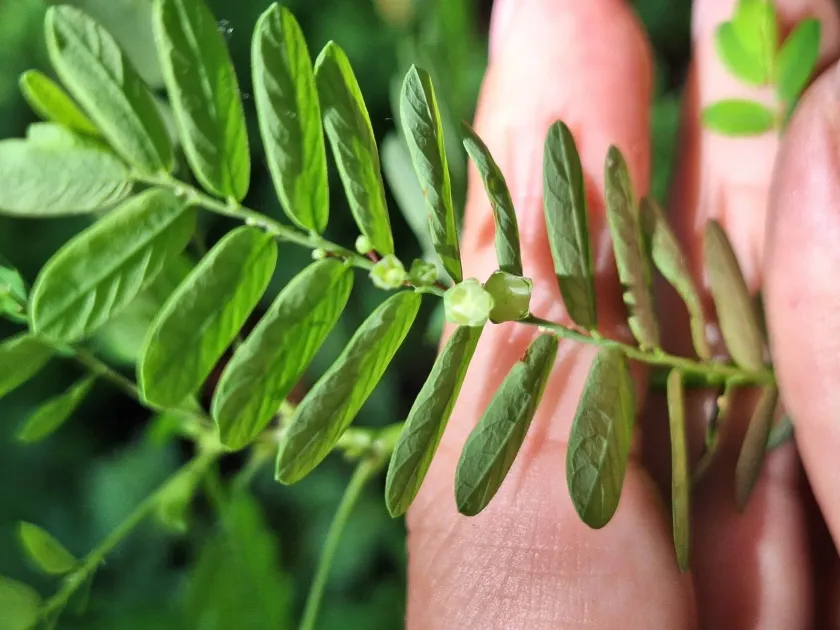
Phyllanthus niruri is an annual herb belonging to the family Phyllanthaceae. It typically grows to a height of 30 to 60 cm, featuring slender, branching stems and small, oblong leaves that appear as if they are pinnately compound.
The plant is distinguished by its small, solitary, greenish-yellow flowers located in the leaf axils on the underside of the branches. The fruit consists of a smooth, spherical, and flattened capsule that bursts when ripe to release seeds.
It possesses a strong taproot system, which helps it anchor firmly in diverse soil types. The plant demonstrates significant regenerative abilities, allowing it to recover quickly from minor mechanical damage in its early growth stages.
The entire life cycle, from germination to seed production, generally takes about three to four months. This rapid cycle allows for multiple generations per growing season in warm climates.
Reproduction is exclusively via seeds. A single mature plant can produce thousands of seeds that remain viable in the soil for several years, creating a persistent weed seed bank.
Where it grows
Phyllanthus niruri is a common weed throughout the tropical and subtropical regions of the world. It frequently infests row crop fields, vegetable plots, orchards, and abandoned agricultural land.
It thrives in loose, moist, and fertile soils. The plant easily adapts to various moisture levels but prefers open areas with high sunlight exposure, as it does not tolerate dense shading from taller plants.
Geographically, it is prevalent across India, Southeast Asia, tropical regions of the Americas, and Africa. In managed agricultural landscapes, it often becomes a dominant species if crop rotation is neglected.
The weed is frequently found in rice paddies, maize fields, and legume plantations. Its presence is most problematic during the early establishment phase of crops when the soil surface is still exposed.
Due to its high adaptability, it can be found on fallow lands, where it acts as a pioneer species, quickly colonizing disturbed areas following soil cultivation.
Harm it causes
The primary harm caused by Phyllanthus niruri is its intense competition with crops for water, nutrients, and sunlight, particularly during the early growth stages of the cultivated plants.
The weed acts as a secondary host for various pathogens and pests that affect agricultural crops. Its presence on the farm increases the overall disease pressure and complicates plant health management.
In cases of high infestation, the dense canopy of the weed can shade out young crop seedlings, leading to stunted growth, reduced vigor, and lower ultimate yields at harvest.
At harvest time, the presence of the weed increases the moisture content and impurities in the harvested material, necessitating additional cleaning and drying costs to prevent grain spoilage.
Economic losses are also incurred due to the high cost of manual labor or chemical applications required to manage this persistent weed in large-scale farming operations.
How to control
Effective management begins with integrated crop rotation strategies. Planting crops that form a dense canopy early in the season effectively suppresses weed germination by limiting light availability to the soil.
Deep plowing can be an effective mechanical control method by burying the seeds to a depth from which they cannot emerge. However, care must be taken not to bring the buried seeds back to the surface in subsequent tillage passes.
Mulching with organic matter or synthetic ground covers is highly effective for vegetable gardens and orchards, as it prevents the light and space requirements the weed needs for germination.
Chemical control includes the use of pre-emergent and post-emergent herbicides. It is crucial to apply these treatments before the weed reaches the flowering stage to prevent the replenishment of the soil seed bank.
- Regular mowing to prevent seed production.
- Strategic application of pre-emergent herbicides.
- Manual roguing in smaller, localized infestations.
- Maintaining high soil fertility to promote crop competitiveness.
Taxonomy
- Latin name
- Phyllanthus niruri
- Family
- Филлантовые
- EPPO code
- PYLNI