
St. John's wort
Hypericum perforatum
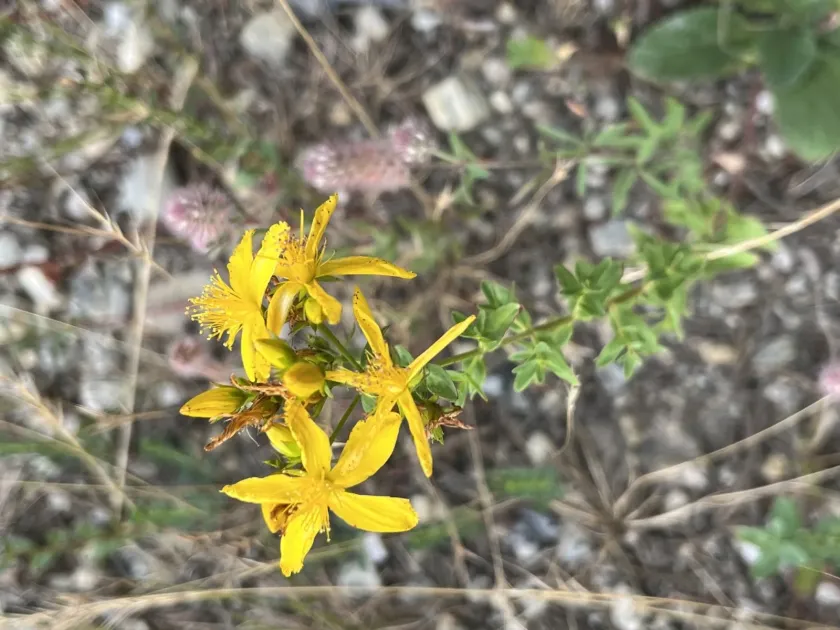
Description
How to tell it apart
St. John's wort (Hypericum perforatum) is a perennial herbaceous plant belonging to the Hypericaceae family. It is classified as a rhizomatous perennial weed.
The plant has erect, branched stems reaching 30–80 cm in height, characterized by two distinct longitudinal ridges. Leaves are opposite, elliptical, and feature translucent glandular dots that resemble perforations when held against light.
Flowers are bright yellow, clustered in cymes, with black glandular dots visible on the petals. The root system is deep and complex, supporting extensive vegetative propagation.
The fruit is a dry capsule containing numerous tiny, brown seeds that maintain high viability in the soil for several years.
The plant contains hypericin, a chemical compound that causes photosensitivity in livestock and gives the herb a distinctive bitter scent when crushed.
Where it grows
St. John's wort thrives in open areas, forest clearings, meadows, and along roadsides. It prefers well-drained soils and is highly adaptable to various environmental conditions.
In agriculture, it is a significant nuisance in pastures, hay fields, and perennial crop stands, where it competes aggressively for space and resources.
It often colonizes disturbed lands, ditches, and field margins, acting as a reservoir for further spreading into cultivated areas via wind or water dispersal.
The plant does not require high soil fertility, making it a persistent colonizer of poor or neglected agricultural lands that lack dense crop coverage.
Mechanical cultivation can facilitate its spread if rhizome fragments are transported across the field during tillage operations.
Harm it causes
The primary concern regarding this weed is its toxicity to livestock. Ingestion leads to severe photosensitization, particularly in light-skinned animals, resulting in skin damage and health complications.
St. John's wort displaces nutritious forage grasses in pastures, significantly reducing the biomass yield and the safety of the grazing area for farm animals.
In perennial forage crops, it competes for moisture, nutrients, and sunlight, leading to the depletion of the main crop stand and reduced hay quality.
The presence of St. John's wort in hay reduces its market value, and removing seeds during the cleaning process increases overall operational costs.
Its deep root system makes it highly resistant to mild environmental stresses, allowing it to maintain dominance in established stands over long periods.
How to control
Effective agronomic management requires deep plowing with soil inversion to disrupt and weaken the deep rhizome system of the weed.
Regular mowing performed before the plant reaches the flowering stage is essential to prevent seed production and deplete energy stored in the roots.
Grazing management is crucial; maintaining healthy, dense pasture cover prevents the establishment of St. John's wort on cleared or sparse sections of land.
Chemical control involves the use of systemic herbicides applied to actively growing plants to ensure the active ingredients reach the root zone for complete eradication.
- Deep tillage and soil inversion
- Repeated mowing before seed set
- Targeted herbicide application
- Maintaining dense competitive forage cover
- Monitoring and clearing field borders
Taxonomy
- Latin name
- Hypericum perforatum
- Family
- Зверобой продырявленный (Hypericaceae)
- EPPO code
- HYPPE