
Galax urceolata
Galax urceolata
Description
How to tell it apart
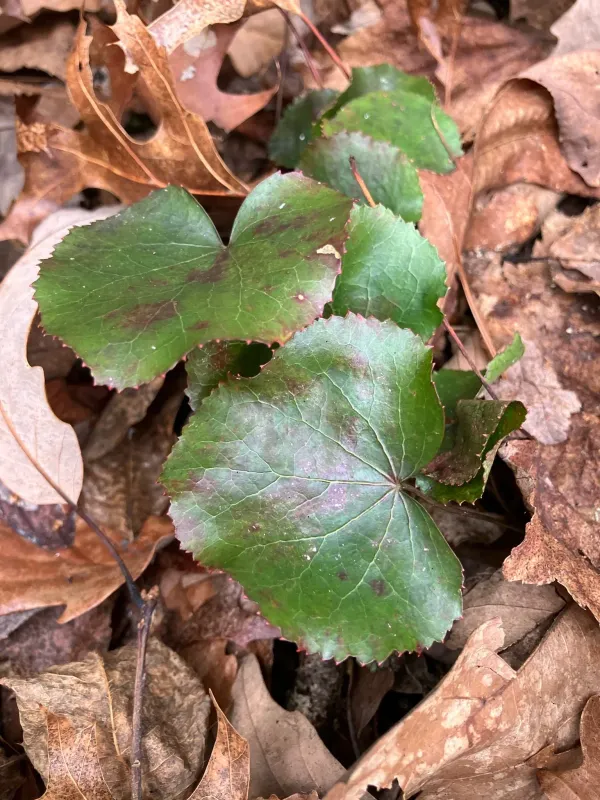
Galax urceolata, commonly known as beetleweed or wandflower, belongs to the Diapensiaceae family. It is a perennial herb characterized by leathery, evergreen basal leaves that are typically heart-shaped or rounded.
The plant produces tall, slender racemes of small white flowers in late spring and early summer. The flowers have a distinct urn-like shape, which is a key identification feature for this species.
Its root system consists of creeping rhizomes that allow the plant to spread horizontally and form dense, persistent colonies that can dominate the forest floor or open soil surfaces.
The leaves possess a shiny, dark green appearance that often turns bronze or reddish in autumn, providing a distinct look throughout the growing season.
As an aggressive colonizer, the plant's ability to propagate through its rhizome network makes it a challenge to eradicate once it establishes a strong foothold in an area.
Where it grows
Galax urceolata thrives in moist, acidic, and humus-rich soils. In its natural range, it is typically found in cool, shaded forests, woodland clearings, and mountain slopes.
In agricultural settings, it often encroaches from adjacent wooded areas into nurseries or shaded crop fields where moisture levels remain consistently high.
The plant is highly shade-tolerant, which allows it to outcompete other ground cover species in environments where light is limited for most sun-loving crops.
It prefers undisturbed or semi-disturbed environments, but once it gains entry into a cultivated plot, it can rapidly colonize moist patches where soil fertility is high.
Because it requires consistent moisture to thrive, it is most invasive in areas near streams, drainage ditches, or in regions with high annual rainfall and poor drainage.
Harm it causes
The primary harm caused by Galax urceolata is its ability to create dense vegetative mats that prevent the germination and growth of other desirable plants by blocking light and space.
The plant's expansive root system competes aggressively for soil moisture and vital nutrients, directly impacting the vigor and productivity of surrounding cultivated crops.
Its presence complicates mechanical tillage and weeding efforts, as the tough, interlaced rhizomes are difficult to remove completely without extensive soil disturbance.
Galax can act as a refuge for specific pests or pathogens, increasing the overall disease pressure on neighboring agricultural plants and requiring closer monitoring.
In landscaping and ornamental production, its invasive nature makes it a significant labor-intensive weed that ruins the aesthetic uniformity and health of plant displays.
How to control
Effective control starts with manual excavation of the rhizome mats. It is critical to remove as much of the root system as possible, as any remaining segments can regenerate into new plants.
Repeated mowing or cutting of the foliage throughout the growing season helps to starve the root system of energy, eventually leading to a reduction in the vigor of the colony.
Chemical control can be achieved using systemic herbicides. Spot treatment with glyphosate-based products is generally effective, provided the application is targeted to avoid contact with nearby crops.
Installing physical root barriers, such as deep-set plastic edging, can prevent rhizomes from spreading into cultivated sections from surrounding unmanaged or forested zones.
Integrated management, including crop rotation, the use of mulch to suppress growth, and timely mechanical cultivation, is necessary to keep Galax populations at manageable levels.
Taxonomy
- Latin name
- Galax urceolata
- Family
- Диапенсиевые
- EPPO code
- GXAAP