
Capraria biflora
Capraria biflora
Description
How to tell it apart
Capraria biflora is a perennial herb or subshrub belonging to the Scrophulariaceae family. This plant typically grows to a height ranging from 50 cm to 100 cm, characterized by a branching woody stem at the base.
The leaves are alternate, lanceolate or elliptical in shape, and feature distinct serrated margins. Their bright green color and prominent venation make them easily recognizable in agricultural landscapes.
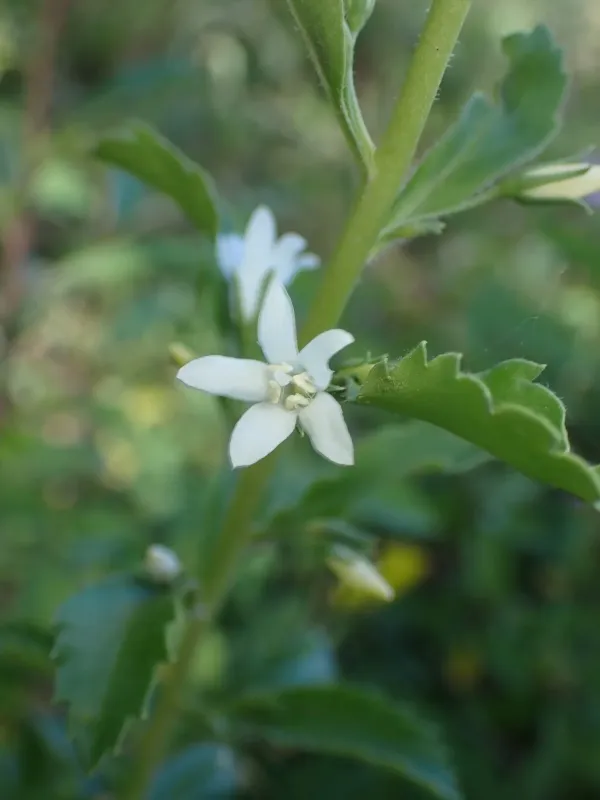
The flowers are small, white to pale cream, and usually appear in pairs in the leaf axils, which is the origin of the specific epithet biflora. The flowering period is extended, ensuring reproductive success over many months.
The fruit is a small, oblong capsule that splits open when mature to release numerous tiny seeds. These seeds are highly dispersible and contribute significantly to the weed's invasive nature in favorable climates.
A robust taproot system allows Capraria biflora to anchor firmly in various soil types and access deep moisture, making it highly resilient during dry spells and competitive against surrounding vegetation.
Where it grows
Native to tropical and subtropical regions of the Americas, Capraria biflora thrives in warm, humid environments. It is widely distributed across the Caribbean, Central America, and South America.
The weed favors disturbed habitats such as roadsides, wastelands, and fallow fields. It easily encroaches into cultivated areas, particularly those with well-drained loamy or sandy soils.
It is frequently problematic in plantations of sugar cane, corn, and various vegetable crops. Its ability to colonize land rapidly makes it a persistent nuisance for farmers in tropical agricultural zones.
Capraria biflora can adapt to both full sun and partial shade, allowing it to survive under the canopy of perennial crops. This versatility increases the difficulty of eradication once it establishes a foothold.
The plant quickly colonizes abandoned or poorly maintained land, serving as a source for further spread into productive fields through wind-blown seeds or contamination in equipment.
Harm it causes
The primary economic impact of Capraria biflora is its aggressive competition with crop plants for water, nutrients, and sunlight. This resource depletion leads to stunted crop growth and reduced yields.
Its deep root system allows it to survive in conditions where crops might be struggling, effectively acting as an invasive competitor that exacerbates drought stress in main crops.
The plant can harbor various pests and plant pathogens, complicating integrated pest management strategies. This necessitates more frequent pesticide applications, increasing the overall cost of crop protection.
Harvesting efficiency is often reduced due to the presence of dense clumps of Capraria biflora, which can interfere with machinery and lead to higher levels of seed contamination in the final grain harvest.
In grazing lands, Capraria biflora is generally considered non-palatable and can outcompete desirable forage species, leading to a degradation of the overall quality of pasture for livestock.
How to control
Mechanical control is effective if performed consistently. Deep plowing and frequent cultivation during the early growth stages help to exhaust the plant's root reserves and prevent the spread of seeds.
Crop rotation remains a fundamental strategy. Planting competitive cover crops that establish quickly can shade out Capraria biflora seedlings, significantly reducing their population over time.
Chemical control involving systematic herbicides, such as glyphosate-based products, is often employed in fallow fields to ensure total eradication of both the foliage and the root system.
In active crop fields, selective herbicide application tailored to broad-leaved weeds is recommended. Timing is critical, with applications most effective before the weed reaches the flowering stage.
- Mowing margins and field edges to prevent the dispersal of seeds into cultivated areas.
- Using high-quality, certified seeds to ensure no contamination occurs at planting.
- Monitoring fields regularly to identify and remove small infestations by hand.
- Implementing mulching techniques in row crops to suppress germination.
Taxonomy
- Latin name
- Capraria biflora
- Family
- Норичниковые
- EPPO code
- CPRBI