
Onionweed
Asphodelus fistulosus
Description
How to tell it apart
Onionweed (Asphodelus fistulosus) belongs to the Xanthorrhoeaceae family. It is a perennial herbaceous plant recognized by its distinctive, hollow, onion-like leaves arranged in a basal rosette.
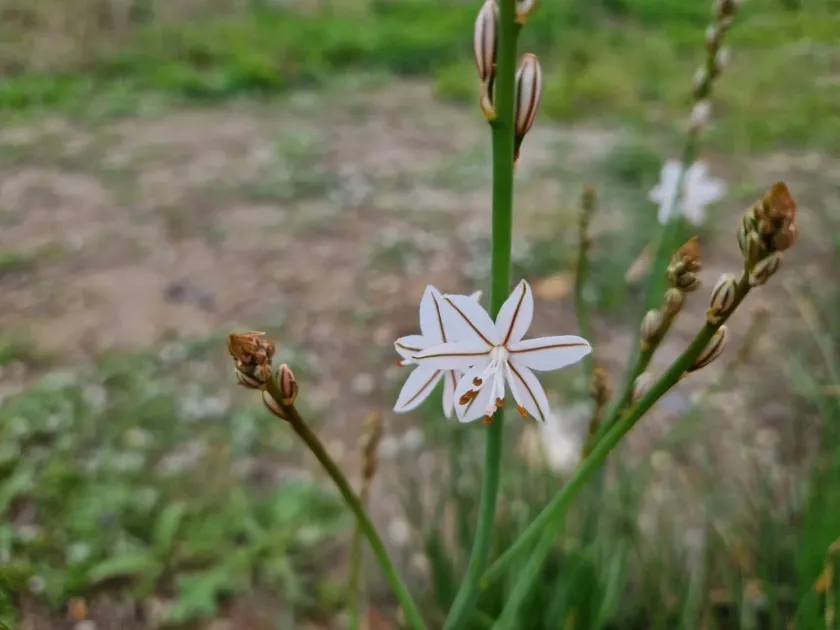
The plant produces upright flowering stalks that can reach up to 70 cm in height, characterized by loose, raceme-like clusters of small, white to pale pink flowers.
A key identifying feature of the flower petals is the presence of a distinct reddish-brown or purple central stripe, which is a common diagnostic characteristic.
Its root system consists of a bundle of fleshy, spindle-shaped roots, which allows the plant to survive adverse conditions and regrow after minor mechanical damage.
The fruits are spherical capsules that release numerous small, black, triangular seeds, which can persist in the soil seed bank for several years.
Where it grows
Originating in the Mediterranean region, onionweed has become a widespread invasive species in many parts of the world, including Australia and North America.
It favors sunny, open environments and thrives in a wide range of soil types, particularly sandy or disturbed soils where competition from other vegetation is low.
Onionweed is a major pest in pastures and grazing lands, where it aggressively colonizes areas, reducing the density of more palatable and nutritious forage species.
In agricultural settings, it frequently infests cereal crops and orchards, particularly in arid and semi-arid climates where its drought tolerance provides a competitive edge.
It is commonly found along roadsides, field margins, and waste areas, which serve as reservoirs for seed dispersal into adjacent productive agricultural land.
Harm it causes
Onionweed is highly invasive; it forms dense stands that effectively suppress the growth of desirable crops by competing for moisture and soil nutrients.
Its presence in pastures is problematic because the foliage is unpalatable to livestock, leading to a significant decrease in the grazing capacity of the affected land.
The prolific production of seeds allows the weed to quickly build up a persistent soil seed bank, making long-term control essential to prevent recurrent infestations.
Because the plant is resilient to harsh environmental conditions, it can establish itself during droughts when crop vigor is low, further exacerbating yield losses.
Additionally, onionweed can harbor various pests and plant diseases, which complicates the integrated pest management strategies required for surrounding agricultural crops.
How to control
Deep cultivation or plowing is an effective mechanical measure to bury seeds deep enough to prevent germination, though it must be repeated to exhaust the soil seed bank.
Timely mowing before the onset of flowering is crucial to stop the life cycle and prevent the shedding of seeds, which is the primary mode of plant propagation.
For localized infestations, manual removal including the complete root system is necessary, as incomplete removal allows the plant to sprout again from remaining root parts.
Chemical control involving systemic herbicides, such as glyphosate, is recommended for managing large infestations on fallow ground or non-crop areas.
- Use selective herbicide regimes within cereal crop rotations.
- Implement strict field monitoring to detect new patches early.
- Ensure equipment is cleaned to prevent the spread of seeds between fields.
Taxonomy
- Latin name
- Asphodelus fistulosus
- Family
- Асфоделовые (как сорный компонент)
- EPPO code
- ASHFI