
Pelican flower
Aristolochia grandiflora
Description
How to tell it apart
The Pelican flower (Aristolochia grandiflora) belongs to the Aristolochiaceae family. It is a vigorous, woody vine capable of reaching massive sizes.
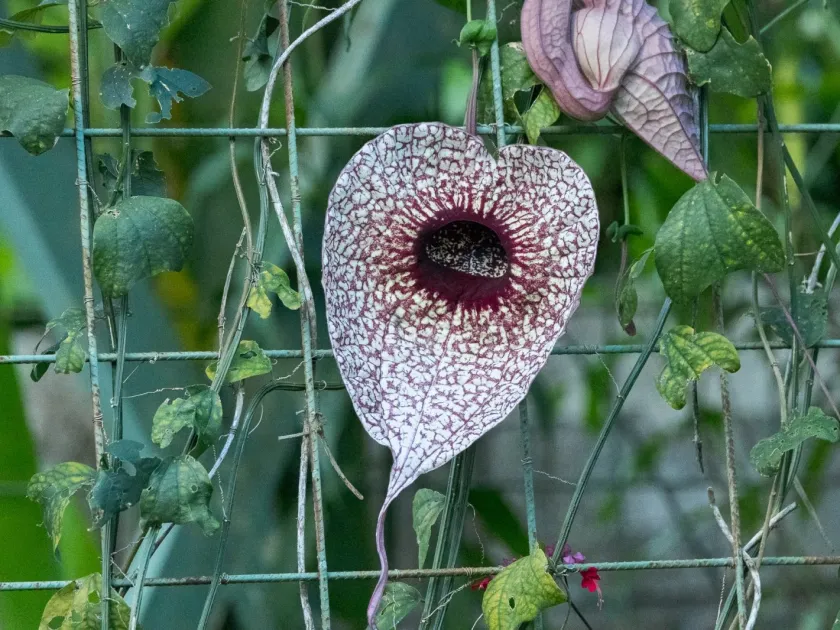
A distinctive feature of the plant is its enormous, bizarrely shaped flowers that resemble a pipe or a gramophone, with long tail-like appendages that emit a foul odor to attract pollinators.
The leaves are large, heart-shaped, and arranged alternately along twining stems that form dense green masses capable of rapidly climbing any available support.
The root system is strong and well-developed, allowing the plant to adapt successfully to various soil types and environmental conditions.
The fruits are large, multi-seeded capsules that burst open upon maturation, ensuring the wide dispersal of seeds into surrounding areas.
Where it grows
The plant is a tropical species native to Central and South America, preferring humid forests and coastal zones where it finds support for vertical growth.
In agroecosystems, it is found in countries with tropical and subtropical climates, where it can invade shelterbelts, orchards, citrus groves, and coffee plantations.
The weed actively uses agricultural structures, fences, and the trunks of cultivated trees as support, which complicates agronomic practices and field maintenance.
It thrives on sites with disturbed soil cover, rapidly colonizing new areas provided there is sufficient moisture and diffused sunlight.
Propagation occurs primarily through seeds, but it can also spread vegetatively if segments of the stem come into contact with moist soil.
Harm it causes
The main danger of the Pelican flower lies in its rapid vertical growth, which leads to the shading of agricultural crops and the suppression of their photosynthesis.
The vines physically damage the branches of fruit trees and ornamental plants, causing structural deformation and reducing the overall productivity of the plantation.
The plant contains aristolochic acid, a highly toxic compound that poses a serious threat to livestock if they ingest the vegetative mass.
The weed actively competes with crops for mineral nutrients and water, depleting the soil horizon within its root zone.
Dense thickets of this weed create favorable conditions for pests and the development of fungal diseases that can subsequently spread to the crops.
How to control
Combating the Pelican flower requires a comprehensive approach, starting with the manual mechanical removal of the vines along with their rhizomes before the flowering phase.
An important step is the regular pruning of all above-ground parts, which depletes the energy reserves of the perennial rhizome and eventually leads to plant mortality.
Chemical control includes the use of systemic, non-selective herbicides applied directly to stem cuts or young leaves.
The application of glyphosate-based products has shown high efficacy when treatments are conducted during the plant's active growth period.
- Mechanical removal of the root system.
- Targeted application of herbicides to stem cuts.
- Regular disposal of plant residues.
- Limiting light access through mulching.
Taxonomy
- Latin name
- Aristolochia grandiflora
- Family
- Кирказоновые
- EPPO code
- ARPGR