
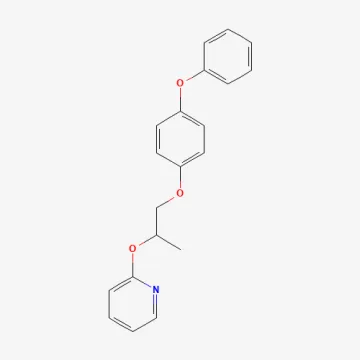
Pyriproxyfen
Description
Mode of action
Pyriproxyfen belongs to the class of juvenile hormone analogs. This active ingredient exhibits potent contact and stomach activity, disrupting the metamorphosis process of pests at various stages of their development.
Upon entering the insect's body, the substance mimics the natural hormone responsible for maintaining the larval stage. This blocks the normal development of the pest, making its transition into the adult stage impossible.
A key feature of pyriproxyfen is its translaminar activity—the ability to penetrate leaf tissues, providing protection even for plant parts that were not directly hit during spraying.
The product effectively acts on eggs, larvae, and pupae, preventing their transformation into imago. This creates a powerful "sterilizing" effect, significantly reducing the reproductive potential of pest populations in orchards and fields.
The substance is characterized by high stability on plant surfaces and resistance to rain wash-off, ensuring a prolonged protective period that can last for several weeks.
What it targets
Pyriproxyfen is widely used to control populations of various scale insects, soft scales, whiteflies, and certain types of Lepidoptera. Its efficacy is proven against the San Jose scale, mealybugs, and psyllids.
The primary area of use includes fruit crops, including pome fruits (apples, pears) and stone fruits. The product is also actively used in vineyards for controlling specific pests.
In greenhouse operations, the substance is essential for protecting vegetable crops and ornamental plants from whiteflies. It effectively eliminates pests in controlled environments where populations multiply rapidly.
The agent effectively impacts pests even in hard-to-reach areas due to its fumigant properties and ability to move through plant tissues.
Using pyriproxyfen allows for a significant reduction in the number of required sprayings, as its effect on egg-laying prevents the development of the next generation of pests.
Rates and timing
Application rates vary depending on the target pest and crop type, typically ranging from 0.1 to 0.5 liters of concentrate per hectare. Exact dosages must be followed according to the manufacturer's specific instructions.
The timing of applications is critical for achieving maximum effect. The optimal time is considered to be the period when larvae emerge from under the shields or at the onset of mass pest colonization.
In orchards, treatments are performed before mass flowering or during the period of active pest flight, guided by pheromone trap data. This allows for the disruption of the reproductive cycle at an early stage.
In greenhouse conditions, the frequency of treatments is determined by the level of infestation and the biological development cycle of the specific whitefly or mealybug species.
It is recommended to use a sufficient volume of working solution to ensure uniform wetting of the entire leaf surface, considering that protection is most effective with full coverage of vegetative organs.
Restrictions
Pyriproxyfen requires strict adherence to safety measures when handling chemicals: the use of personal protective equipment for skin and respiratory protection is mandatory for personnel.
The product is relatively safe for many beneficial insects, including predatory mites, but direct exposure to beehives should be avoided as it may have a negative effect on active pollinators.
Exceeding the allowed number of treatments per season is not recommended to avoid the development of pest resistance. It is advisable to rotate pyriproxyfen with insecticides from other chemical classes.
The product should be stored in its original packaging in dry, cool warehouse areas, out of reach of children and pets, and away from food products.
When disposing of containers and solution residues, ecological standards must be followed, preventing the substance from entering water sources or drainage ditches, as it is hazardous to aquatic organisms.
Status in the European Union
Approved in the EU
- CAS number
- 95737-68-1
- Approved from
- 01.08.2020
- Approval until
- 31.07.2035
- ADI
- 0.05 mg/kg bw/day
- ARfD
- 1.0 mg/kg bw
- AOEL
- 0.04 mg/kg bw/day
EU status is for reference only and does not replace national registration in your country.