
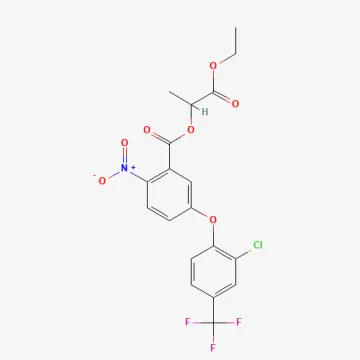
Lactofen
Description
Mode of action
Lactofen belongs to the diphenyl ether chemical class. It is a highly effective contact herbicide that is absorbed primarily through the leaves of weed plants.
The mechanism of action is based on the inhibition of the protoporphyrinogen oxidase (PPO) enzyme. Disruption of this process leads to an accumulation of protoporphyrin IX, which causes oxidative stress and destruction of cell membranes.
After contact with the product, weeds stop growing almost instantly. Visible symptoms of damage, such as chlorosis, necrosis, and rapid wilting, appear within hours of application.
Lactofen has a pronounced photoactive effect. The efficiency of the herbicide significantly increases in the presence of sunlight, which is an important factor to consider when planning application timing.
Unlike systemic products, lactofen has minimal mobility within the plant. Therefore, to achieve maximum results, it is essential to ensure complete coverage of the leaf surface with the spray solution.
What it targets
The product is designed to control a broad spectrum of broad-leaved weeds. It is particularly effective against species that are difficult to manage with other chemical agents.
The target spectrum includes invasive weeds such as pigweed, common ragweed, velvetleaf, smartweed species, and nightshades.
Lactofen effectively suppresses young weeds that are in the active growth phase. The best results are achieved when treating during the early stages of weed development.
Using the product helps reduce competitive pressure on the main crop during critical vegetative periods, promoting healthy root and biomass development.
It is important to remember that lactofen has limited effectiveness against perennial grasses, so it is often used in tank mixes or as part of an integrated weed management strategy.
Rates and timing
Application rates for lactofen depend on the weed species composition and the growth stage of the crop. Typically, the product is applied at rates of 0.2 to 0.4 liters of active ingredient per hectare.
The optimal application time is when weeds are in the 2-4 true leaf stage. Overgrown weeds significantly reduce the effectiveness of the treatment.
For preparing the spray solution, a standard water volume of 200 to 300 liters per hectare is used. Ensuring uniform, fine-droplet spray distribution is crucial for success.
Application is often timed for post-emergence treatment of soybeans. The crop should be in the one-to-three trifoliate leaf stage to avoid potential phytotoxicity.
Repeated applications of lactofen within a single season are generally not recommended, as this may damage the main crop and exceed permissible soil residue limits.
Restrictions
A primary limitation is the potential for temporary phytotoxicity on soybeans. After spraying, spots or leaf burns may appear, which usually disappear within a week.
Treatment is not recommended under stress conditions, such as drought, high humidity, extreme temperatures, or insect infestation.
Adhering to specific temperature requirements is essential. Ideal conditions for application include moderately warm weather with intense sunlight to activate the herbicide.
Lactofen has high soil persistence, so strict crop rotation must be followed. The half-life of the substance should be considered before planting subsequent crops.
- Use personal protective equipment for skin and respiratory protection.
- Prevent spray drift onto neighboring fields of sensitive crops.
- Store in sealed containers away from food and feed.
- Do not allow the product to contaminate water sources.
Status in the European Union
Not approved in the EU
- CAS number
- 77501-63-4
EU status is for reference only and does not replace national registration in your country.