

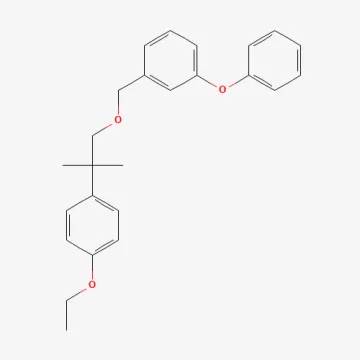
Description
Mode of action
Etofenprox is a unique insecticide belonging to the non-ester pyrethroid class. Unlike traditional pyrethroids, its chemical structure lacks the ester linkage, which significantly enhances its stability when exposed to intense UV radiation and sunlight.
The mode of action involves direct disruption of the insect's nervous system. It acts by interfering with sodium channels in the nerve cell membranes, blocking the transmission of nerve impulses.
This disruption causes immediate paralysis in insects, a phenomenon known as the 'knockdown' effect, leading to rapid cessation of feeding and subsequent death within hours.
Etofenprox acts primarily through contact and ingestion. Therefore, achieving comprehensive coverage of the plant surface during application is essential for optimal efficacy against targeted pests.
Due to its selective toxicity profile, it is often preferred in integrated pest management (IPM) programs as it has a relatively lower impact on many beneficial entomophages compared to other neurotoxic insecticides.
What it targets
Etofenprox provides broad-spectrum control against various sucking and chewing insect pests that pose significant threats to agricultural yields.
It is particularly effective against aphids, thrips, leafhoppers, stink bugs, and early larval stages of lepidopteran species that cause foliage damage.
The substance is widely recognized in rice cultivation for its exceptional control over the rice water weevil and various rice-infesting midges.
- Aphids and Thrips
- Lepidopteran larvae
- Rice water weevil
- Sucking insect pests
It serves as an excellent tool for managing populations that have developed resistance to traditional ester-based pyrethroids due to its specific molecular structure.
Rates and timing
Application rates for etofenprox vary depending on the target crop, the specific pest species present, and the infestation density observed in the field.
It is best practice to initiate applications as soon as the pest population reaches the economic threshold to prevent irreversible damage to the crop development stages.
Optimal results are achieved using high-quality spraying equipment that ensures uniform deposition of the product across the treated vegetative parts of the plants.
To ensure long-term effectiveness, users should implement an anti-resistance strategy by rotating etofenprox with insecticides featuring different modes of action.
Applications should ideally be performed under moderate climatic conditions, avoiding peak heat and high wind speeds to reduce spray drift and maximize adherence.
Restrictions
Strict adherence to safety protocols is required, including the use of appropriate personal protective equipment (PPE) during mixing and application to prevent dermal or respiratory exposure.
The product is toxic to aquatic organisms. Great care must be taken to maintain buffer zones and avoid spray drift into ponds, streams, or other water bodies.
Users must comply with pre-harvest intervals (PHI) specified on the product label to ensure that residue levels in the final agricultural produce remain within safe regulatory limits.
Etofenprox is dangerous to pollinators. Applications must be avoided during crop flowering stages or whenever bees are actively foraging in the area.
Always store the chemical in its original, sealed container in a cool, dry place, strictly separated from food, animal feed, and fertilizers to prevent contamination.
Regulatory
Status in the European Union
Approved in the EU
- CAS number
- 80844-07-1
- Approved from
- 01.01.2010
- Approval until
- 31.03.2027
- ADI
- 0.03 mg/kg bw/day
- ARfD
- 1.0 mg/kg bw
- AOEL
- 0.06 mg/kg bw/day
Hazard classification (CLP)
Aquatic Acute 1 - H400Aquatic Chronic 1 - H410Lact. - H362
EU legislation
EU status is for reference only and does not replace national registration in your country.
Content graph
Connections · Etofenprox
Most often together:
Marketplace